There are no records of arrests - and certainly no convictions - for the shootings of the spring of 1869. The circuit court grand jury, led by foreman John M. F. Erwin of Greenwood, expressed with "deepest regret...[its] utter inability to obtain evidence sufficient to bring to justice a large number of the guilty." Erwin commeneded the "hearty cooperation" of the county's civil officers and citizens, but, conveniently or not, conceded that "crime of the deepest die goes unpunished." Erwin was a prominent merchant and sometime politician who bitterly opposed the Bureau and its aims. His stately home stands in Greenwood today.
The violence of the spring terrified Jackson County African Americans. T. Thomas Fortune later recalled the extraordinary efforts of his father, state assemblyman Emanuel Fortune, to fortify and defend their home. Fortune wrote that white men stalked the home day and night and vividly recalled tripping early one morning over a man sleeping beside a shotgun at a position overlooking their homestead. Emanuel Fortune sensed his "life to be in danger at all times." Finally, Fortune heeded the counsel of his friends, white and black, to leave. He distributed his property among his relations and neighbors and packed up his family, settling in Jacksonville. His son rued that his father received almost no compensation for the farm, business, and chattel he had assiduously built and accumulated since Emancipation.
Showing posts with label E. Fortune. Show all posts
Showing posts with label E. Fortune. Show all posts
Wednesday, April 01, 2009


Friday, October 19, 2007
Hamilton's brawl in Walton County, Florida
Dale Cox, author of the authoritative "Battle of Marianna" brought to my attention John L. McKinnon's "History of Walton County." Published in 1912, "History of Walton County" is unabashedly sympathetic to the white southerners and critical of carpetbaggers and Republicans. Amazingly, McKinnon has a detailed account of Hamilton's the melee with Walton County whites while on a campaign to organize black voters prior to the election for delegates to the state constitutional convention. Emanuel Fortune describes this brawl in his testimony before the Congressional "Ku Klux Klan" committee that interviewed witnessed in Jacksonville in late 1871.
First is Fortune's account:
"I went with Colonel Hamilton to Walton County to inform the people there of the constitutional convention, and to get the republicans there to go in favor of the convention. He and I went into the court-house; the audience, of course, were generally back country people, very poor people. After the meeting, at which he and I both spoke, we were informed that while speaking there was some disposition for a disturbance. After the meeting we all dispersed, and in going to the hotel some colored men came to us, and we were advising them what to do on the day of election. After they came several more came, and there was a right good bunch around us, some eight or ten. The white fellows, who were off at a store not very far off, got very bitter about it, as they did not want us to communicate with them at all. They came hustling up toward us, and Colonel Hamilton, I suppose, got mad, for he spoke very abruptly to them. They pitched right in for a fight, and there was quite a scuffle. Men were going to cut him in the back, but I kept them off. One picked up a rail and it broke in two, and they turned and fled. It all ended by his tripping in the wild grass, and this fellow got on him and choked him. That ended the fight, because he considered that he had the best of it." [Source: Testimony Taken by the Joint Select Committee to Inquire Into the Conditions and Affairs in the Late Insurrectionary States," House Report No. 22, pt. 13, 42nd Congress., 2d Sess (Washington 1972), 98-9.]
Next is McKinnon's version of the same event with some prefacing material:
[342] The carpetbaggers followed close behind us with their best speakers in negro precincts. W. J. Purman, Hamelton and Dickson, with their headquarters at Marianna, were the campaigners through Walton. They made extrava-
[343] gant, rash promises to the negroes, reminding themselves no doubt of the old rhyme:
“Much to promise and little to give Causes the fools in comfort in live.”
“The forty acres and the mule,” was their leading promise to the end. The whites attended all of their meetings when they knew of them, and would take them up on their rash, foolish promises; but they would hold secret, night meetings, and say things that they would not dare say in the presence of the whites. They were good speakers and educated as to books, but bankrupts as to character. They called an open advertised meeting at Euchee Anna in the open day time, pretty much every negro voter was there. This was called their “Grand Rally Meetings.” The white voters were there in force, the meeting was held in the old courthouse in the southern part of the town. They had to be checked up several times in their extravagant statements. They lead us to believe they wanted their opponents to reply when they were through. But when they finished, they had a tacit understanding with the negroes to meet them for private instructions, and they went out in a body in the direction of the hotel where they had stopped, not by the street way, but direct through a grove that intervened, and when they were well in the grove and near the hotel they stopped. Hamilton, a tall, stout, rawboney man of fair complexion, light hair and blue eyes weighing about two hundred pounds, 38 years old, a college athlete in appearance, stood talking to the negroes as they gathered around him in the grove. The white voters who moved on to the business part of town by the street way,
[344] saw that he had stopped and was talking with the negroes. Bill Bell, a farmer from Knox Hill, a full match in build, weight, and years, for Hamilton, with dark complexion, black hair and dark eagle piercing eyes, said, “Men we have had enough of this today, and those negroes have had enough, let’s go over there and send these rascals over the river and the negroes home, where they belong?” “All right” came from everybody. They walked up to the circle, Bell in the lead, while Hamilton was yet speaking. Bell with his right hand on the left shoulder of one negro, his left on the right of another, made a breach and enlarged at the circle, walked right up in front of Hamilton and said in loud unmistakable tones, using severe ugly adjectives, “See here, Hamilton, these negroes have had enough of this stuff today, you are fixing them up to be put under the ground. You were allowed to say too much in yonder building, you can’t sneak out here in these bushes and stir up the devil in them, and let me tell you right here, if you know what is best for you, you had better cross the river and crawl up in your hole.” Hamilton straightened himself up boastingly with an air of bravery, and he was brave with his big crowd of negroes around him and said, “I am a free born American citizen exercising the right of free speech and don’t want to be disturbed in this way.” “You are,” said Bell, “a free born American jackass risking the dangers of a free fight!” “You are more of a jackass than I am,” said Hamilton. As these words fell upon Bell’s ears, he dealt a blow with his right fist directly in Hamilton’s breast that staggered him. It was promptly returned and while these blows and fencings were flying swiftly there went up a cry from the white voters, “A fair fight, a fair fight!” They clenched each
[345) other then and went at it right. The negroes indiscriminately took to the woods, running pell-mell in every direction. Purman and their negro driver made for the hotel, got their horses and were ready on the ground a little while to go for the river. Bell proved more than his equal in a clenched wrestle. Hamilton realizing his situation cried out, “Am I left alone, have they all deserted me?” It was then the white voters laid hold on them, loosed their hold on each other, pulled them apart and there they stood unexhausted in front of each other with their faces scratched a little, the greatest damage done being to their Sunday clothes. Hamilton got into the carriage with Purman and the negro driver and they went down the Douglass Ferry road, the negro driving with such flying speed through the sand and dust that flew so thick and high above their heads, that they were hid from view. When they got to the ferry it was night. They urged Mr. Campbell to help them across that night, that they might be safe. When they had told him what had befallen them that day at Euchee Anna, he told them that it would not be safe to try crossing the river at night and that he knew all of those men and would guarantee their safety with him that night, that all they wanted was for them to let the negroes alone. They stopped until morning in security and passed over the river, and that was the last of carpetbaggerism in Walton. The most remarkable and creditable thing in this whole affair was, that there was neither knife or pistol drawn during the encounter, notwithstanding in these times, and on such occasions men went armed to the teeth. [Source: Florida Heritage Collection http://susdl.fcla.edu/fh ]
The versions are generally similar but with some different details. Fortune's account is an eyewitness testimony recited almost four years after the incident. McKinnon is unclear about whether he was present at the event or is relating an account he heard from others. Either way, McKinnon, publishing his book in 1911, McKinnon was presumably remembering events that took place more than forty years earlier. The major differences are McKinnon's placement of Purman at the scene which Fortune does not mention. Considering that Fortune was, if anything, closer personally to Purman, and mentioned both men repeatedly in his testimony, it is unlikely that Fortune forgot Purman's presence. Hamilton and Purman were so closely associated, particularly in the disdain of white Floridians, that McKinnon probably naturally assumed that Purman was also in Walton County that day. Also, McKinnon does not mention Fortune's role in the fight and instead dismissively refers to the "negro driver." Fortune, conversely, was an able speaker and a candidate for the convention and, according to his son, a fierce and courageous fighter. Fortune, however, does not refer to the desperate scramble to get out of the county and "across the river" that McKinnon describes with obvious amusement. The accounts do agree in the general nature of the fight and that Hamilton got the worst of it. Hamilton, of course, despite his height and youth, suffered from a disabling leg injury and may have already had the chronic respiratory ailment that tormented him for years. McKinnon's physical description of Hamilton conforms with other contemporary accounts, except that McKinnon overestimates Hamilton's age by 11 years.
First is Fortune's account:
"I went with Colonel Hamilton to Walton County to inform the people there of the constitutional convention, and to get the republicans there to go in favor of the convention. He and I went into the court-house; the audience, of course, were generally back country people, very poor people. After the meeting, at which he and I both spoke, we were informed that while speaking there was some disposition for a disturbance. After the meeting we all dispersed, and in going to the hotel some colored men came to us, and we were advising them what to do on the day of election. After they came several more came, and there was a right good bunch around us, some eight or ten. The white fellows, who were off at a store not very far off, got very bitter about it, as they did not want us to communicate with them at all. They came hustling up toward us, and Colonel Hamilton, I suppose, got mad, for he spoke very abruptly to them. They pitched right in for a fight, and there was quite a scuffle. Men were going to cut him in the back, but I kept them off. One picked up a rail and it broke in two, and they turned and fled. It all ended by his tripping in the wild grass, and this fellow got on him and choked him. That ended the fight, because he considered that he had the best of it." [Source: Testimony Taken by the Joint Select Committee to Inquire Into the Conditions and Affairs in the Late Insurrectionary States," House Report No. 22, pt. 13, 42nd Congress., 2d Sess (Washington 1972), 98-9.]
Next is McKinnon's version of the same event with some prefacing material:
[342] The carpetbaggers followed close behind us with their best speakers in negro precincts. W. J. Purman, Hamelton and Dickson, with their headquarters at Marianna, were the campaigners through Walton. They made extrava-
[343] gant, rash promises to the negroes, reminding themselves no doubt of the old rhyme:
“Much to promise and little to give Causes the fools in comfort in live.”
“The forty acres and the mule,” was their leading promise to the end. The whites attended all of their meetings when they knew of them, and would take them up on their rash, foolish promises; but they would hold secret, night meetings, and say things that they would not dare say in the presence of the whites. They were good speakers and educated as to books, but bankrupts as to character. They called an open advertised meeting at Euchee Anna in the open day time, pretty much every negro voter was there. This was called their “Grand Rally Meetings.” The white voters were there in force, the meeting was held in the old courthouse in the southern part of the town. They had to be checked up several times in their extravagant statements. They lead us to believe they wanted their opponents to reply when they were through. But when they finished, they had a tacit understanding with the negroes to meet them for private instructions, and they went out in a body in the direction of the hotel where they had stopped, not by the street way, but direct through a grove that intervened, and when they were well in the grove and near the hotel they stopped. Hamilton, a tall, stout, rawboney man of fair complexion, light hair and blue eyes weighing about two hundred pounds, 38 years old, a college athlete in appearance, stood talking to the negroes as they gathered around him in the grove. The white voters who moved on to the business part of town by the street way,
[344] saw that he had stopped and was talking with the negroes. Bill Bell, a farmer from Knox Hill, a full match in build, weight, and years, for Hamilton, with dark complexion, black hair and dark eagle piercing eyes, said, “Men we have had enough of this today, and those negroes have had enough, let’s go over there and send these rascals over the river and the negroes home, where they belong?” “All right” came from everybody. They walked up to the circle, Bell in the lead, while Hamilton was yet speaking. Bell with his right hand on the left shoulder of one negro, his left on the right of another, made a breach and enlarged at the circle, walked right up in front of Hamilton and said in loud unmistakable tones, using severe ugly adjectives, “See here, Hamilton, these negroes have had enough of this stuff today, you are fixing them up to be put under the ground. You were allowed to say too much in yonder building, you can’t sneak out here in these bushes and stir up the devil in them, and let me tell you right here, if you know what is best for you, you had better cross the river and crawl up in your hole.” Hamilton straightened himself up boastingly with an air of bravery, and he was brave with his big crowd of negroes around him and said, “I am a free born American citizen exercising the right of free speech and don’t want to be disturbed in this way.” “You are,” said Bell, “a free born American jackass risking the dangers of a free fight!” “You are more of a jackass than I am,” said Hamilton. As these words fell upon Bell’s ears, he dealt a blow with his right fist directly in Hamilton’s breast that staggered him. It was promptly returned and while these blows and fencings were flying swiftly there went up a cry from the white voters, “A fair fight, a fair fight!” They clenched each
[345) other then and went at it right. The negroes indiscriminately took to the woods, running pell-mell in every direction. Purman and their negro driver made for the hotel, got their horses and were ready on the ground a little while to go for the river. Bell proved more than his equal in a clenched wrestle. Hamilton realizing his situation cried out, “Am I left alone, have they all deserted me?” It was then the white voters laid hold on them, loosed their hold on each other, pulled them apart and there they stood unexhausted in front of each other with their faces scratched a little, the greatest damage done being to their Sunday clothes. Hamilton got into the carriage with Purman and the negro driver and they went down the Douglass Ferry road, the negro driving with such flying speed through the sand and dust that flew so thick and high above their heads, that they were hid from view. When they got to the ferry it was night. They urged Mr. Campbell to help them across that night, that they might be safe. When they had told him what had befallen them that day at Euchee Anna, he told them that it would not be safe to try crossing the river at night and that he knew all of those men and would guarantee their safety with him that night, that all they wanted was for them to let the negroes alone. They stopped until morning in security and passed over the river, and that was the last of carpetbaggerism in Walton. The most remarkable and creditable thing in this whole affair was, that there was neither knife or pistol drawn during the encounter, notwithstanding in these times, and on such occasions men went armed to the teeth. [Source: Florida Heritage Collection http://susdl.fcla.edu/fh ]
The versions are generally similar but with some different details. Fortune's account is an eyewitness testimony recited almost four years after the incident. McKinnon is unclear about whether he was present at the event or is relating an account he heard from others. Either way, McKinnon, publishing his book in 1911, McKinnon was presumably remembering events that took place more than forty years earlier. The major differences are McKinnon's placement of Purman at the scene which Fortune does not mention. Considering that Fortune was, if anything, closer personally to Purman, and mentioned both men repeatedly in his testimony, it is unlikely that Fortune forgot Purman's presence. Hamilton and Purman were so closely associated, particularly in the disdain of white Floridians, that McKinnon probably naturally assumed that Purman was also in Walton County that day. Also, McKinnon does not mention Fortune's role in the fight and instead dismissively refers to the "negro driver." Fortune, conversely, was an able speaker and a candidate for the convention and, according to his son, a fierce and courageous fighter. Fortune, however, does not refer to the desperate scramble to get out of the county and "across the river" that McKinnon describes with obvious amusement. The accounts do agree in the general nature of the fight and that Hamilton got the worst of it. Hamilton, of course, despite his height and youth, suffered from a disabling leg injury and may have already had the chronic respiratory ailment that tormented him for years. McKinnon's physical description of Hamilton conforms with other contemporary accounts, except that McKinnon overestimates Hamilton's age by 11 years.
Saturday, February 03, 2007
Business Dealings of Our Cast
Reconstruction era Florida provided a free-for-all business environment in which members of the state legislature eagerly participated. Lists of incorporators of various transportation and related land improvement companies reveal complex, constantly shifting personal alliances. In 1868, Senator Osborn and his associate, M.H. Alberger, appear as stockholders of the Southern Inland Navigation and Improvement Co. Alberger also appears as a shareholder with Florida's other senator, Gilbert, on the stockholder list of the St. Johns and Halifax Navigations and Improvement Co. Gilbert, however, joined Emanuel Fortune and Purman in the Jacksonville and St. Augustine Railroad Co.
The infamous (at least to readers of this blog) Great Southern Railroad Company brought together such disperate figures as Reed, Carse, T.W. and A.C. Osborn, Stearns, Jenkins, Charles Hamilton, Purman, Josiah Walls and Pearce. Purman and U.S. Marshall Wentworth held shares in the Pensacola and Barrancas Railroad Co. Robert Meacham was an owner of the Monticello and Georgia Railroad Co. Charles Hamilton appears together with Purman, Wentworth, J.Q. Dickinson, Jackson Co. Sheriff Thomas W. West and Charles E. Dyke Jr. (!) as shareholders of the West Florida Railroad Co. to stretch from St. Andrews Bay (modern Panama City) to Marianna). Walls and Meacham joined in the Suwanee and Inland Railroad Co. and Purman, Wentworth and Malachi Martin (!) were among the owners of the Florida Telegraph Co. Hamilton and Purman appear on one last time together on the shareholder list of the Aquatic and Tropical Plant Propagating Co. (to cut a canal to Lake Okeechobee to be consolidated with the efforts of Osborn's South Inland Navigation and Improvement Co.). All these companies were created in 1868, immediately upon readmission of the state and meeting of its legislature. Is it doubtful that Hamilton ever saw a cent from these ventures. Purman continued to have business interests for years in the state.
The infamous (at least to readers of this blog) Great Southern Railroad Company brought together such disperate figures as Reed, Carse, T.W. and A.C. Osborn, Stearns, Jenkins, Charles Hamilton, Purman, Josiah Walls and Pearce. Purman and U.S. Marshall Wentworth held shares in the Pensacola and Barrancas Railroad Co. Robert Meacham was an owner of the Monticello and Georgia Railroad Co. Charles Hamilton appears together with Purman, Wentworth, J.Q. Dickinson, Jackson Co. Sheriff Thomas W. West and Charles E. Dyke Jr. (!) as shareholders of the West Florida Railroad Co. to stretch from St. Andrews Bay (modern Panama City) to Marianna). Walls and Meacham joined in the Suwanee and Inland Railroad Co. and Purman, Wentworth and Malachi Martin (!) were among the owners of the Florida Telegraph Co. Hamilton and Purman appear on one last time together on the shareholder list of the Aquatic and Tropical Plant Propagating Co. (to cut a canal to Lake Okeechobee to be consolidated with the efforts of Osborn's South Inland Navigation and Improvement Co.). All these companies were created in 1868, immediately upon readmission of the state and meeting of its legislature. Is it doubtful that Hamilton ever saw a cent from these ventures. Purman continued to have business interests for years in the state.
Sunday, June 04, 2006
Freedmen's Tribute to William Purman
William Purman, Hamilton's boyhood neighbor and friend, resigned his War Department post in Washington and came to Marianna, Fl. in early 1866. In mid-April, after Hamilton's request, Purman was appointed the Freedmen's Bureau's civilian agent for Jackson County (Hamilton was the military officer responsible for Jackson, Washington, Calhoun and Holmes Counties). Purman was appointed "Special Agent" at Marianna at the salary of $100/month beginning in June. Technically, Purman was Hamilton's subordinate, but after a short time it became apparent that they served as equals. Hamilton's attention and time were disseminated across his geographically large jurisdiction where much of the freedmen's population was widely dispersed. Dissatisfied by civilian agents previously appointed by Osborn, Hamilton was compelled to spend time away from Jackson County riding around the other counties under his responsibility. This burden became heavier in February 1867 when the Bureau terminated the positons of civilian agents in Hamilton's territory. In mid-February, Purman was instructed to report to the Bureau's Florida headquarters for further orders and in March he was appointed Bureau Agent at Volusia City. In April, the Bureau directed Purman to investigate Ralph Ely's ill-fated freedmen's colony in New Smyrna, FL. Shortly after Purman's reassignment, Hamilton wrote to his Bureau superiors requesting the return of Purman ("an Agent of very considerable efficiency- with a heart devoted to the Freedmen’s cause") to Jackson County [Hamilton to A.H. Jackson, March 21, 1867].
Hamilton's letter was soon followed by a remarkable document delivered to Colonel John Sprague, the superior Bureau officer for Florida:
"Colonel:
Your petitioners would lay their humble request before you in this form and ask you to restore to us our good Freedmen Bureau Agent, W.J. Purman, if it is possible to do so. As you are now Head we ___ to you in confidence asking this, though we know you are doing everything for the best.
He worked day & night for our good. Starting up our education. Starting up our societies. Making speeches. Settling our Difficulties, and explaining our difficulties and settling them up for us. explaining to all through the country how to work, how to make money & how to live in peace and harmony. We feel that he has done all of us more good than any man we ever saw. The people all want him back. And therefore Colonel if you can possibly do it, We will pray and thank you for it, with our blessings on the whole Freedmens Bureau. We remain your humble petitioners."
This letter, dated March 25, 1867 was signed by 70 freedmen led by Rev. Emanuel Fortune. Well-known signers include Calvin Rogers (later constable and murdered in early 1870), Benjamin Livingston (later state legislator, county commissioner and Marianna postmaster and councilman and the last black office holder in Jackson County prior to Jim Crow's entrenchment), Jesse Robinson (later state legislator and justice of the peace), Rev. Fuller White (later county commissioner and Marianna councilman), and Isham White (county commissioner) [For biographical information, Canter Brown, Jr., Florida's Black Public Officials, 1867-1924].
Purman was dispatched in May by the Bureau on an inspection tour of West Florida and returned to Jackson County by the end of June 1867.
Hamilton's letter was soon followed by a remarkable document delivered to Colonel John Sprague, the superior Bureau officer for Florida:
"Colonel:
Your petitioners would lay their humble request before you in this form and ask you to restore to us our good Freedmen Bureau Agent, W.J. Purman, if it is possible to do so. As you are now Head we ___ to you in confidence asking this, though we know you are doing everything for the best.
He worked day & night for our good. Starting up our education. Starting up our societies. Making speeches. Settling our Difficulties, and explaining our difficulties and settling them up for us. explaining to all through the country how to work, how to make money & how to live in peace and harmony. We feel that he has done all of us more good than any man we ever saw. The people all want him back. And therefore Colonel if you can possibly do it, We will pray and thank you for it, with our blessings on the whole Freedmens Bureau. We remain your humble petitioners."
This letter, dated March 25, 1867 was signed by 70 freedmen led by Rev. Emanuel Fortune. Well-known signers include Calvin Rogers (later constable and murdered in early 1870), Benjamin Livingston (later state legislator, county commissioner and Marianna postmaster and councilman and the last black office holder in Jackson County prior to Jim Crow's entrenchment), Jesse Robinson (later state legislator and justice of the peace), Rev. Fuller White (later county commissioner and Marianna councilman), and Isham White (county commissioner) [For biographical information, Canter Brown, Jr., Florida's Black Public Officials, 1867-1924].
Purman was dispatched in May by the Bureau on an inspection tour of West Florida and returned to Jackson County by the end of June 1867.
Friday, April 28, 2006
A friend "through all the combats that were fought"
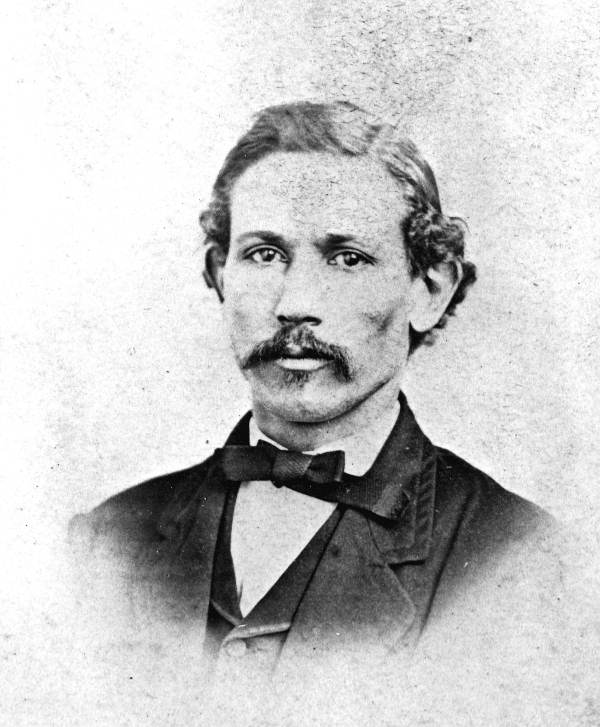
Rev. Emanuel Fortune
[Photo from Florida State Archives]
Born a slave, Emanuel Fortune was a prominent minister and leading Republican party activist in post-War Jackson County. He was elected as a delegate to the Florida constitutional convention in early 1868 and as a Jackson County representative in the state legislature. A close friend of the Bureau agents, he accompanied Hamilton on voter registration and organization drives and may have saved Hamilton's life during a brawl with whites in Walton County. Fearing for life after the Finlayson/Purman shooting, Fortune fled with his family to Jacksonville in the summer of 1869. His son, Timothy Thomas Fortune benefitted from Purman's patronage when the latter was in Congress and became one the leading African American journalists of the early 20th century.
Subscribe to:
Posts (Atom)