Thursday, May 31, 2012

"Recollections of Some Noted Floridians"

Following is an engaging memoir recalling some of the prominent figures in mid-19th century Florida politics, including several men from Jackson County.  The source is the Frank Papy Woodword Collection at the Florida State Archives in Tallahassee.  The author is probably Alfred L. Woodword Jr. (1841-1915).


RECOLLECTIONS OF SOME NOTED FLORIDIANS
During the decade lying between the years 1840 and 1850, the little town of Marianna nestled on the west bank of the Chipola river in Jackson County, Florida, possessed as intelligent and cultured society, and could boast of as fine an array of legal and literary talent as could be found in many of the larger cities of the South.
These man and their families were settlers in the newly acquired territory of Florida, and had emigrated principally from the border states of Kentucky, Tennessee, Virginia and North and South Carolina, lured by prospects of pecuniary or political gain in the new Eldorado. Some were appointees to office under the federal government; some had brought their slaves from the older states, had cleared vast plantations from the pri­meval forests and were now established as prosperous planters; while others still had come as volunteers in the Indian wars, had fought under General Jackson and were so pleased with the country that they had de­cided to remain and adopt it as their permanent home. There were very few of that class of adventurers among them so common to a new country, the old ante-bellum hospitality and courtliness was the rule and not the exception, and characterized their intercourse in all departments of life.
The St. Joseph's Convention - which gave Florida the constitution under which she had been admitted to the Union - had been held in 1838; the Indians through the energy of General Jackson had been conquered, transported or pacified, except a few roving bands of creeks which made occasional raids from Georgia; and taken altogether, no more ideal place for a permanent home could, be found than Jackson county and Marianna. Game was abundant - deer and wild turkey - while the waters of the Chipola teemed with fish, it being no uncommon, thing to catch "Rock Fish" weighing from fifteen to twenty pounds a species of fish which I have never seen in any other river in Florida.
Railroads were unknown.  The shriek of the locomotive had never desecrated the stillness of the virgin forests, and tales of such wonders were listened to with bated breath as they were recounted by more fortunate ones - recent comers - who had actually seen them with their own eyes.
The commerce of the community was all carried on by water - from Columbus, Georgia, by steamboat to Chattahoochee, thence by wagon to Marianna; or from the latter place by barges propelled by poling down the Chipola, through the Dead Lakes to the Big River, thence by boat again to Apalachicola. St. Joseph and its railroad to Blountstown were already waning and being shorn of their glory by the new queen city at the mouth of the river, which had secured a monopoly of the cotton trade down the .river, including Columbus, Eufaula, Ft. Gaines and Bainbridge, and was the only shipping port for a vast area of country.
At Chattahoochee was the ferry for crossing travelers from West Florida to the Capital and East Florida.
The families located at Marianna had a very pleasant social custom of visiting around among each other after supper, and at these family gatherings the conversation generally assumed a literary, legal or political turn. Often have I seen gathered in my father's parlor fifteen or twenty gentlemen with their wives - men who either then or afterwards were distinguished in the history of the state. Though quite a child at the time, I think I can recall some of them sufficiently to present them to you.
There was the towering form of Judge A. E. Maxwell, who I think, has a son still living in Pensacola. The expression on his feathres [sic] was always one of extreme kindliness and mild dignity. Then there was Judge Thomas Baltzell, almost, if not quite, as tall as Judge Maxwell, but heavier built. He was decidedly of a Lincoln type of man, having a mas­sive head with short hair inclined to curl. He was afterwards Chief Justice of the Supreme Court of Florida. He had been a member of the St. Joseph's Convention with such men as John C. McGehee, who was president of the Secession Convention in 1861. Other members of the St. Joseph Convention were D. L. Yulee, afterwards United States Senator. William Marvin, afterwards governor of Florida; Alfred L. Woodward, afterwards receiver of the United States Land Office under President Buchanan.
One of the most prominent figures in these social gatherings was Judge George S. Hawkins, who was, I think, at the time Judge of the Western Circuit and afterwards member of Congress. He was rather under medium size, neat and dapper in appearance, and noted for his keen wit and biting sarcasm - also remarkable for having buried six wives and was then living with his seventh. Many were the joking comparisons made (not in his presence I assure you) between him and Henry the VIII of England. Then there were Thomas and Allen Bush, the latter of whom afterwards became the author of Bush’s Digest Laws of Florida.
But I would be sadly recreant to personal feeling and long, stand­ing friendship did I fail to mention the “noblest Roman of them all," Major Jesse J. Finley, who came from Tennessee, and earned his title fighting the Florida Indians under General Jackson himself.
He was a very large man; tall and well-formed, a man of com­manding presence and courtly bearing and a dignity tempered by great sweetness of disposition and suavity of manner. Before coming to Florida in 1846, he had served in the Arkansas legislature and been mayor of Memphis, Tennessee. He represented. Jackson County in the Florida Senate in 1850, was made Judge of the Western Circuit in 1861, Judge of the Confederate Court in 1862, resigned that position and entered the Con­federate army- as a private and rose successively to captain, colonel and Brigadier General; commanded the Florida Infantry in the army of Tennessee, and was wounded at the battle of Resaca and again at Jonesboro. Removed from Marianna to Lake City in 1865, was a member of Congress from 1875 to 1879 from the Second Congressional district.
In 1879 he was appointed Judge of the Fifth Judicial Circuit and after serving for six years retired from active life and died in 1904. A record duplicated by but few men.
Where are they now, these noble men of yore, who served their country well and fell asleep? The Chipola still flows on "to join the brimming river," winding in and out among her sluggish lakes. The sweet notes of the boatman's bugle is heard no more. The barges have long since rotted at their moorings; the neigh of the iron horse startles the echoes of her caves and swamps as he leaps her narrow stream.
Resuming my recollections of those Floridians who resided in Marianna during or about the period of time of which I am writing, there looms up very prominently one who afterwards filled a very important and responsible position in-the history of the state during a crisis of great danger and which required unusual courage, firmness and statesmanship. I refer to Colonel John Milton, who was elected governor in 1860 or 1861, and guided the ship of state during the disturbed and dangerous period of the four years of civil strife.
He was known as "Florida's War Governor," and as such was con­fronted by problems peculiarly intricate and difficult which few can now realize of appreciate.
My first recollection of him was when I was a small child in my father's home in Marianna. He resided then on his plantation several miles out from town. I knew him better during the dark days of strife when I was a young soldier, and shall ever hold him in grateful remem­brance for his unvarying kindness to one who was "only a private." These were the days when the noble women of Tallahassee met as a sewing society in one of the rooms at the capitol to make uniforms and knit socks for the men at the front, and it was the duty of the governor to provide the mate­rial from which their handicraft was wrought—grey jeans and woolen yarns. When I chanced to be at home on furlough I sometime dropped in and saw them at their work. Were I an artist I could paint those groups from memory--Mrs. Ellen Call Long; her sister Mrs. Brevard; Mrs. J. J. Williams; Miss Mag Brown, daughter of ex-Governor Brown. Mrs. Pearce, Mrs. Woodward; Mrs. T. J. Perkins; Mrs Selim Myers; a host of Maxwells from Belle Aire, Mrs. Hopkins, Mrs. Dan and George Meginniss, and many more. How they did sew and--talk.
How they would pause now and then to listen with breathless inter­est to some item of news from Tennessee or Virginia, while here and there one attired in darker robes walked silently aside while the big tears would course each other slowly down her cheeks. Such an one had "received news from the front," and such a heart was breaking for a grey-clad warrior who rested in a far off nameless grave.
Governor Milton was ever courteous, gallant and sympathetic, while ordinarily full of life and jest.  Then the scene changes and memory on shifting wing transports me once again to childhood's sunny realm, and I see one calm, sedate, dignified; yet with sunny mein and pleasant face, pass athwart the stage. A large man with a heart and brain to correspond. One who wore the ermine without a stain--W. D. Barnes. Who lifted the bench out of the realm of politics and served with spotless integrity as Comptroller under Bloxham, and several terms thereafter.
Then there approaches one with heavy frame and martial tread. One with force of character and earnestness of purpose stamped upon his every lineament—-John H. McClellan, a fitting man to compile a Digest of Florida laws. I knew him when he commanded on Virginia's plains a company of the immortal 2nd Florida Infantry under the chivalric George T. Ward.
Leonine in his courage, and steadfast in his friendship yet enjoying a joke with the best, as witness how he bore with us when we guyed so unmercifully when he accidently rolled the barrel over the bluff and down among the tents of the 14th Louisiana, camped just below us, and who thought he did it purposely, and in consequence "had it in" for the 2nd Florida.
Just now there dropped from my pen the name of Bloxham.
No true Floridian can write that name without an extra heart­beat and a quickening of the pulse; nor can he pass "the lapse of earth" where rests his honored head without an involuntary slackening of his step and lifting of his hat. Bloxham! He needs no eulogy here. My hand is not worthy to write his epitaph. Patriot, orator, statesman. Patient under misconstruction--genial under criticism; pursuing still his high ideals when least appreciated by men. Caesar and Napoleon left no off­spring, and nature gave us no model when she sent us Bloxham.
We will see thy genial face no more, nor hear thy ringing voice.


[Located at: M73-10, Frank Papy Woodward Collection, Box 1, folder 8, Alfred L. Woodward Writings, FSA] 

Tuesday, April 17, 2012

A Jackson County Ante-Bellum Wedding

When nearly eighty years old, Mrs. Fannie Bryan Chapman wrote a series of articles for the Pensacola Journal newspaper recalling her youth and life in Jackson County.  Anyone who has read my book knows of my admiration for Mrs. Chapman.  In addition to her courage and talents, she was also a very charming writer, as evidenced by the following article dated Dec. 19, 1909.

A COUNTRY WEDDING SIXTY YEARS AGO


By Mrs. Fannie Chapman, Marianna, Fla.


In compliance with a request of the editor of The Pensacola Journal for acontribution to that widely-read paper, I have decided on a sketch of country weddings many years ago when Jackson county was new.


In those days the population was dense in spots. The people of whom I shall write were mostly cultured citizens of older states and held to the customs of the communities from which they came. They were from well-to-do up to wealthy, but wealth created no class distinction among them. All were neighbors and friends. The homes were not palatial, but large and comfortable. Hospitality was of the most generous Bible type.


When there was a prospective wedding everyone was kindly interested, although engagements were often the French style-not made public. Something might transpire that the marriage was not consummated and no explanations would be necessary. I never knew an instance of failure, but our elders wished their girls to be kept on the safe side.


When the parents had sanctioned the engagement the preparations began. The pigs for barbecue, without which no southern banquet was considered complete, were at once selected and put in pens to fatten. The flock of turkeys and chickens and ducks received attention, no matter if the wedding was months off. Long engagements were not favorably considered, three or four months being thought quite long enough unless there was some reason for delay.


When the set time approached for the marriage preparations began in earnest. The bridesmaids were selected and invited to spend as much time of the intervening days at the home of the bride as was convenient. There were always from four to eight in number. The groom selected his attendant friends. There were no “best man” nor maids nor matrons of honor. All we knew of such maids was of those in queens’ palaces. A maid of honor at a wedding looks lonesome to me now, marching along behind the pairs of ladies and gentlemen. There was no “giving away of the bride”; her father and mother did that when they consented to the marriage. The cake-making took from a week to ten days. Invitations were issued by hundreds, and all written by hand. It would not have been considered at all complimentary to have used printed notes. Brides and their attendant ladles all wore white, but the maids were not confined to any particular style in the making. Gentlemen wore the regulation black broad--- coat and white vest.


When all things were in readiness, the house was opened to the coming guests. Upon the arrival of the bridesmaids they were ushered into the bride’s chamber, while the groom and his friends were taken to another. As soon as the girls had put on the last finishing touch to their own and the bride’s toilet, they went into the family sitting room and the gents were notified that the ladies were ready to receive them. The minister was placed in position in the parlor and the crowd divided to make an open way for the coming party. The pairs of attendants took their places to the right and left of the minister, the bridal pair advancing a step or two between the lines.


When the marriage ceremony that united them for life “till death us do part” was completed, congratulations were cordial and profuse. There was no wedding march, as there could not have been space enough in those large parlors for one to sit at a piano. The music came after- all along in the evening at intervals.


About eleven o’clock supper was announced. The bridal party led the way to the dining room-which might aptly be styled a banquet hall. The sight of one of those wedding supper tables would be a revelation to the present generation. There were pyramids of lighted candles, the only means of illuminating at that time; pyramids of the best of cake, at least two and a half feet high, decorated with icing in a manner that might well be the envy of noted confectioners; and cakes, fruit cakes, square cakes, big cakes, little cakes, layer cakes and every sort we know anything about or our neighbors could suggest; orange, apples, grapes, the finest of candies, among which was a good supply of the old-time kisses with a wish of some sort wrapped in the fancy paper. Ice cream was not among the delectable dainties, as ice could not be had, but the richest of syllabub and boiled custard instead of the cream. The meats were served from a side table, also hot coffee and tea. Dining rooms were twenty feet square-in fact, most of the rooms were of that size- and it may be imagined what a jolly crowd could do in such a room, and at such a table.


It took at least two hours with all the dispatch possible to get through with the supper for all the guests. As there were no trips abroad taken, the people stayed as late as they pleased, and it was often near the dawning of another day before the house was quiet. The attendants were expected to dine with the family next day, also any visitors who might be in the house when dinner was announced.


The receptions all came after the wedding and continued for a week. But few bridal presents were offered and these were not expected. The parents and near relatives were the donors of housekeeping goods and furnishings. After the complimentary parties and dinners were all over, the young couple went to their own home and settled down to their new life. Had it been the custom to give such numberless and costly presents in that far-away time, it would have been done. It comes in very nicely to have all the silver, cut glass, china and table linen provided by the friends of one’s youth, but such offerings would have been in very bad taste then.


While discussing this subject with a friend of long ago in the presence of one of her young daughters, the girl said such extravagance was a sinful waste of good material. Perhaps it was, but we and our friends enjoyed it and the retrospection is delightful now. I shall never see the like again. I wish I could one more time in my life.

Tuesday, March 13, 2012

Jackson County Civil War Database: The Unknowns

My goal for the Jackson Co. FL Civil War Database project is to try to get a handle the devastation of the war on Jackson County as represented by the deaths of its men connected to military service. To make any kind of statistical sense of the numbers, we need a stable, fixed pool to evaluate.  I've chosen the 1860 census for that purpose.  Yes, I know that some residents were not counted in that census, some departed from or moved to Jackson Co. in the interim between the census taking and the end of the war, and some "absentees" or newcomers enlisted in Jackson Co. companies or are even buried in Jackson County.  But I'm not counting these 1860 absentees or newcomers, because then there will never be a goal post in sight.  The pool of 1365 white males of military service age  (which I'm defining as from age 13 through 46 inclusive in 1860) is a significant pool and large enough, I believe, to assume that these absentees and newcomers even out (any statisticians want to chime in?).

Last post I mentioned I was resonably confident that 240 Jackson Co. men (whites of military age), who appeared in the 1860 census, died in or as a result of military service.  But I also mentioned that there are about 240  (i) white males of military service age in the 1860 Jackson Co. census, (ii)  who do not appear in the 1870 Census; and (iii) whom I cannot otherwise reasonably confirm as surviving the war through various sources (e.g., other census searches, genealogy sites, CSRs etc).  I stress "reasonably" confirm, because if someone has a discharge or is listed as captured on their CSR in April 1865, I'm crediting him as "s/w" (survives war).  If the discharge or capture was from earlier, I'm putting them in the "unknown pool."  The goal is not to guess but be as confident as we can that these men lived to see the war's end.  If we can find out their actual living place in 1870 and their date and location of death, even better. I'm also tracking military units.

To push this project forward, I'm posting below my list of 237 unknowns with their ages in the 1860 census.  Several of these men are here, it will be obvious, because they have very common names or share names with other Jackson Co. men of simliar ages and it was impossible for me to be "reasonably" sure in later records which man was which.  A lot of these guys, about 90, I have FL unit listings for.  Some are puzzling because they are familiar names, but with no post-1865 records on line. I very much welcome anyone's help on this.  You will be credited for the information you share. As I've written before, I'm actively seeking people to collaborate with.  History belongs to everyone.

Bevis, James P. 13

Bird, James 13

Blount, Jacob A. 13

Brantley, Francis A. 13

Cook, Eldridge 13

Johnson, William 13

Johnson, William 13

Johnson, William 13

Long, Joseph J. 13

Nugen, Wiley 13

Padgett, John 13

Plair, John S. D. 13

Powers, Henry 13

Rawls, Franklin 13

Register, Ezekiel 13

Shealds, Joseph 13

Webb, Vinson 13

Williams, Thomas 13

Wilson, David 13

Bayles, Irwin 14

Dainn, Thomas W. 14

Hurst, William 14

Jordan, Arthur C. 14

Lacey, Judson R. 14

Middleton, John M. 14

Morrow, Hugh E. 14

Padgett, J. C. 14

Parker, James 14

Parsons, William 14

Patterson, James 14

Rains, Sinaka 14

Alford, Jessee 15

Beckwith, William 15

Blackburn, Charles H. 15

Calhoun, W.B. 15

Conner, Robert 15

Maddux, Samuel D. 15

Parker, Asbury 15

Wadford, Wesley 15

Coulliette, George 16

Hall, Ferney 16

Jones, Arnobius 16

McDaniel, George S. 16

McNealy, William 16

Parsons, Joseph 16

Smith, Alexander 16

Whitesides, William 16

Berry, Henry 17

Bowles, Henry 17

Brantley, Harris M. 17

Carlisle, Benjamin 17

Carter, Stafford 17

Dickson, Benjamin 17

Lacey, William W. 17

Skipper, C. J. 17

Spence, Richard 17

Stanley, Jerry 17

Turner, John 17

Baxter, John D. 18

Coulliette, Joseph 18

Cox, Green 18

Davis, Columbus 18

Dykes, Riley 18

Jackson, Andrew 18

Long, Aaron 18

Owens, Richmond D. 18

Owls, A. H. 18

Parson, Joseph 18

Powers, Alonzo W. 18

Taylor, William 18

Carroll, Thomas 19

Lacey, James M. 19

Larimore, Russel 19

Roberts, John 19

Sapp, Noah 19

Webb, John M. 19

Williams, Nathan 19

Arnold, Thomas 20

Avery, A. W. 20

Brett, James W. 20

Croom, William 20

Daniels, Harrison 20

Lockey, Simeon 20

Boyd, Dawson 21

Devaughn, Robert 21

Herbert, George 21

Johnson, A 21

Jones, M. W. 21

Raiborn, Atha 21

Shepherd, Nathan 21

Sims, James 21

Spence, William 21

Stanley, John N. 21

Daniels, Samuel 22

Hall, Burrel 22

Hart, Thomas 22

Howard, Abraham 22

Johnson, Daniel F. 22

Knight, John 22

Long, O.R.F. 22

Munn, George C. 22

Pare, E. C. 22

Powers, William E. 22

Sapp, Allen 22

Simpson, Joseph 22

Simpson, Joseph 22

Stewart, James 22

York, Martin 22

Anderson, Joel F. 23

Bradberry, William 23

Hall, James W. 23

Heiring, Martin 23

Lee, Thomas 23

Oppenheimer, Edward 23

Pelt, Francas 23

Rogers, Reuben 23

Russell, James 23

Williams, William 23

Bayles, John 24

Bunch, Daniel 24

Bush, E. B. 24

Coonrod, Rowell 24

Crouche, Matthew A. 24

Cutts, Elisha 24

Gammon, John W. 24

Gilbert, Thomas 24

Larimore, Thomas H. 24

Rhodes, William 24

Robinson, John I. 24

Simpson, Benjamin 24

Sullivan, James 24

Wood, Wright 24

Cadle, William 25

Fields, John C. 25

Finley, Lewis 25

Hofheimer, Samuel 25

Kilbee, John C. 25

Lambert, Jasper 25

Neel, Lafayette 25

Owens, William E. 25

Patterson, Joseph J. 25

Rivers, Richard 25

Sims, Jasper 25

Vickery, Joseph S. 25

Bissell, Calvin 26

Compton, William W. 26

Dickerson, Samuel 26

Hall, James C. 26

McSwain, Daniel. E. 26

Perryman, A. 26

Plair, J. M. 26

Stanley, John 26

Ward, John W. 26

Webb, Manning A. 26

Corbett, Nicholas 27

Griffith, Joseph H. 27

King, John D. 27

Raburn, John L. 27

Riles, J. M. 27

Turner, James T. 27

Hollice, John 28

Lambeth, Allen 28

McCoy, W. C. 28

Saunders, William A. 29

Bazzell, Benjamin 30

Brock, Evan 30

Finley, Henry F. 30

Hart, Thomas 30

Maples, Thomas 30

Owens, John 30

Price, W. H. 30

Snipes, Martin J. 30

Sweringen, John L. 30

Taylor, William 30

Williams, Berry 30

Allison, William 31

Brantley, Thomas D. 31

Ernest, E. G. 31

Hendley, William J. 31

Russell, S. B. 31

Merriman, Joshua J. 32

Bullock, Robert 33

Godwin, Spartman 33

Houston, Thomas 33

Scurlock, Thomas J. 33

Bryan, William 34

Colwell, George 34

Daniel, B.M. 34

Baxter, Jacob E. 35

Cowen, James A. 35

Hall, James 35

Harrison, Edwin 35

Hartsfield, Charles N. 35

Jackson, J. W. 35

King, John D. 35

Newsom, Daniel A. 35

Sims, Isaac 35

Stephens, Benjamin 35

Bazzell, James A. 36

Boatwright, Isaac 36

Dozier, E. M. 36

Elmore, John W. 36

Faulk, George 36

Gainer, William 36

Hurst, Franklin 36

McDaniel, Henry 36

Hughes, William H. 37

Pender, James W. 37

Smith, John 37

Watson, Nathan S. 39

Brooks, William 40

Brown, Rufus 40

Buchanan, Henry 40

Carlisle, Wilson 40

Cobb, Columbus C. 40

Cook, Thomas F. 40

Dade William 40

Farley, William A. 40

Land, Thomas J. 40

Sullivan, James 40

Dillard, Joseph 42

Gilbert, Alexander 42

Allen, Isaac 44

Cox, Allen J. 44

Harvey, William B. 44

Moree, Moses 44

Whitesides, John 44

Belcher, Arvin 45

Bird, Archibald 45

Brown, James 45

Devaughn, George 45

Powers, William 45

Spence, William 45

Williams, John 45

Middleton, Stevens 46

Wilcox, J. A. J. 46

Tuesday, February 07, 2012

How Many Jackson County Men Died in the Civil War? The Answer (sort of) Below

How many Jackson County men served in the Civil War?  How many died in service of the Confederacy or, for a few, in service of the Union?  These are great questions and the wealth of Jackson County data available makes the answers approachable, although ultimately impossible to firmly ascertain.   
Who served?  A lot of men and boys volunteered at the war’s outset.  At first the age ranges were relatively narrow as confirmed by the CSA’s first conscription act in 4/1862 which, in addition to extending the enlistments of all twelve month volunteers to 3 years, required all white males between 18 and 35 to enlist.  A second act in 10/62 extended the age limit to 45 and a third act in 2/64 drew in all men from 17 to 50 (17s and over 45s serving in reserve corps).   A number of categories of exemptions applied, including planters who owned twenty or more slaves: at least 33 Jackson Co. men fell under this exemption, but most of these served, at least in home guard units.  We'll look at the actual service numbers at later date.
For purposes of these preliminary numbers, we’ll use a few assumptions. First regarding age: the 1860 census gives ages for that summer. Examination of previous and subsequent census numbers shows that a lot of these ages are estimates, but presumably with more than a thousand names, this problem should average out (any statisticians object?).  A boy of 17 in the spring of 1864 would likely have been 13 in 1860.   Men of 50 in the spring of 1864 would have been 46 in the 1860 Census.   There are many outliers: children as young as 9 in the 1860 census are credited as serving in Home Guard units (hello Frank Baltzell!) as well as some men in their 60s and 70s, up to the oldest war death of Francis Allen (about 75 when killed at Marianna), but there are exceptions.
Here is the basic number: there are about 1365 white males in the 1860 census within the draftable age range.  About 240 can be reasonably confirmed as dying as a direct consequence of military service or the war from 1861 through mid-1865.  The ultimate fate of 254 is unknown.  The remaining 871 are documented in some form or another as surviving the war, whether for a few months or decades.   Therefore, for the broadest age range (13 to 46 year olds in the 1860 census):  63% survived the War, 17.58% perished and 18.6% are unknown.   If we restrict the numbers just to those whose fates are known, the death rate rises to 21.6%.
Looking at the unknowns, we have service information for about 75.  For purposes of discussion, we’ll assume that the reason that half these men are unknown is that they were killed and missing in action.  This assumption will place the death stat at exactly 20%.
But, you say,  these numbers are misleading.  True, only about 1/3 of 13 year olds have service records, even for home guard units.  Two-thirds of 1860 fourteens, on other hand, served.  So we’ll put aside the 80 thirteen year olds including 4 deaths and 19 knowns.  And on the upper range, if we scan down to find an age cohort where we know that more than 50% served in units, we have to go down to age 42.   Cutting off this top range excludes another 80 including 9 deaths and 16 unknowns.  The symmetry of 80 is a coincidence.
So, removing the 13s and the 43 -46ers:
1205 males 14 through 42: 227 deaths (18.84%); 219 unknown (18.17%), leaving 63% surviving the war.   Putting aside the unknowns, the death rate is 23%. Playing the 50% game from above for unknowns who served, we are again left with about a 20% death rate of males within the conscription age range.    It is crucial to emphasize this last point because these death rates do not deal with the actual numbers who served.  Those death rates will be much higher.  But a simplistic, preliminary examination indicates that Jackson County was certainly within the Confederacy’s average range (perhaps on the lower end of average) for war death rates.

Next steps include looking at the rates of death for actual service.  It would also be interesting to explore the “rich man’s war, poor man’s fight” theory by examining service and death rates by wealth and slave ownership (Joseph Glathaar’s research on Lee’s army shows this to be a myth: the wealthy were more motivated and served and died at higher rates).  We can also look closer at the 240 dead and break those numbers down as far as KIAs, deaths from diseases, eastern and western theaters, etc.
Notes:
These numbers do not in any way address the wounded and maimed.  We know from pension records, for example, that there were many amputees.  Certainly hundreds of men suffered from physical impairment and what is known today as PTSD.  
A subject not addressed, but might be the most elusive research topic is the service, in whatever form it may have taken, of Jackson County’s African Americans in the Confederate armies.

There’s obviously a lot more work that can be done with this data (as well as more data to retrieve and verify) that I don’t have much time for.  Any volunteers?

Tuesday, January 31, 2012

Catawba Tribe

Here's a link to "Patriot Chiefs and Loyal Braves" by Mr. Steven Pony Hill. It's a fascinating history of the Catawba Indians of the Apalachicola Valley, with emphasis on Jackson and Calhoun counties. (I had no idea that most "mulattos" listed in the 1860 Jackson County census were Catawbas). The section on navigating the color line in the late 19th and early 20th century is especially poignant.  It's all worth a read:
http://sciway3.net/clark/freemoors/NativeAmericans.html

Tuesday, January 03, 2012

Confederate Monument and Cemetery ....in Westchester County, NY!


I was amazed to learn recently that there is a large Confederate monument, surrounded by a ring of graves of Confederate army veterans, located only about ten minutes from my house in suburban Westchester County, New York.  The granite obelisk in the picture above is quite large, maybe 50 feet tall (one newspaper says 60 feet on top of a top foot base), and stand in the Mount Hope Cemetery in Hastings-on-Hudson, New York.  It is quite prominent - by far the largest and tallest monument in the hillside cemetery and plainly visible from Saw Mill River Road below.  It is certainly congruous enough not to attract the attention of passing drivers. I've been by it many times and never noticed it.  On inspection, however, it is impressive, very well maintained and the surrounding circle of graves are well marked, most with unit names, and well preserved.  Interestingly, on my visit, the graves were each flanked by a small United States flag.  
The monument was erected in 1897 and reads on one side: "Sacred to the Memory of the Heroic Dead of the Confederate Veterans Camp of New York."  Supposedly, this is the only such monument and dedicated cemetery section north of the Mason-Dixon line, excluding, I suppose the prison camp cemeteries. 
I plan to research and perhaps write about the story behind this monument, its dedication (that drew some opposition, but not much), the individuals buried around it and its preservation.

Sunday, December 18, 2011

Remembering author Caroline Hentz - in 1892

Caroline Lee Hentz was a popular American writer of the ante-bellum era. A Massachusetts native, she married a Southerner and lived the last few years of her life in Marianna.  Although she wrote several successful novels, today she is remembered mostly in academic circles for The Northern Planter's Bride, her rebuttal to Uncle Tom's Cabin.  The following 1892 piece from a Thomasville, GA newspaper shows, however, that decades after the war, Mrs. Hentz was still remembered with great affection. 
FROM: (Thomasville, GA) Daily Times-Enterprise, Jan. 20, 1892

Tuesday, November 22, 2011

John Quincy Dickinson and Civil War and Reconstruction Memory

The regimental history of the 7th Vermont Vols., written by William C. Holbrook, contains some pages remembering John Q. Dickinson. The description of Dickinson's time in Florida is not attributed to any witness or first person source and, consequently, is more significant for the impressions it conveys, rather than any factual information contained.  First the excerpt with my comments following:

FROM:  A NARRATIVE OF THE SERVICES OF THE OFFICERS AND ENLISTED MEN OF THE 7TH REGIMENT OF VERMONT VOLUNTEERS (VETERANS) FROM 1862 TO 1866
by William C. Holbrook (New York, 1882)

[151] CAPT. JOHN Q. DICKINSON
On September 13th, [1864] Lieut. John Q. Dickinson, who for some time had acted as regimental Quartermaster, was commissioned as such. He discharged the duties of that office, which were by no means light, very acceptably to the regiment and with much fidelity and ability. He was subsequently made Captain of Company F, and was honorably discharged for disability October 10th, 1865. Upon leaving the service, like many other of the Union soldiers, he elected to cast his lot with the people of the South. For a time he was engaged in the lumber business in Florida in partnership with Col. D.. B. Peck. But after a little they relinquished that business and Col. Peck returned to the North. Capt. Dickinson, however, remained in Florida, and entered somewhat into politics, and finally secured a public office at Mariana, I believe. He was an educated gentleman, and a facile and pleasing writer. In disposition he was as agreeable as he was amiable, and was the last against whom it would be expected that any one would harbor harsh or hostile feelings. Nevertheless, it seems that his superior attainments did occasion much hatred and jealousy on the part of the Floridians of the neighborhood, who wanted no "Yankees" to administer their affairs, or to hold office in their State. A trifling newspaper article, or something of the kind, was seized upon as a pretext to inform Mr. Dickinson that his presence was not wanted at Mariana, and accordingly a notice, emanating from that most fiendish and hellish of all organizations, the Ku Klux Klan, was served upon him in due form, whereby he was warned to depart under the penalty of death. To this threat he paid no attention.

[152]
TRAGIC DEATH OF CAPT. DICKINSON.


His friends, however, were so apprehensive of the great danger he incurred, that they entreated him not to let it pass unheeded, and urged him to return home. But he was not willing to retire, as he expressed it, "in the face of the enemy," and would not have it said that he had been driven from his post by any such menaces, and he determined to remain where he was, notwithstanding he received two or three subsequent warnings that his life would surely be taken if he did not depart. Finally, one evening, after he had closed his office, a message was sent to his house that he was wanted there on important business. Not suspecting danger he started to comply with this request. It was then dark. Shortly the report of guns was- heard. Either that evening, or the following morning, his dead body was found beside the road riddled with bullets. He was murdered by the Ku Klux. His remains were sent home, and on their arrival at New York a meeting of a few of his old comrades and friends was held, at which appropriate resolutions were passed. Although he escaped the rebel balls on more than one battle field, he at last fell a victim to rebel hate, which was as unrelenting for years after the war as it was during its progress. He believed that every man was privileged to reside where he pleased, and that, in the South as well as at the North, the right of free speech was not to be abridged or taken away. In seeking to maintain these principles of liberty he died. He was as much a martyr as though he had fallen in full armor, and in the thickest of the fray."
[http://books.google.com/books?id=Mx9CAAAAIAAJ&ots=kxgiYeVtCb&vq=dickinson&dq=%22john%20q.%20dickinson%22%20florida&pg=PA151#v=onepage&q&f=false]

Holbrook, a colonel in the 7th VT, likely knew his brother officer well, and the description of JQD’s ability as an officer and general observations about his personality suggest they derive from personal acquaintance. Certainly, the recollection of JQD’s education and amiability are consistent with the accounts of his friends. Holbrook does not state the source for his account of JQD's post-war career, but a clue is found in his introduction where he thanks the comrades who assisted him in his research. First on his list of acknowledgements is Col. David B. Peck, one of JQD’s closest friends and post-war business partner. Peck’s condolence letter to JQD’s parents suggests that the two men were frequent correspondents. For example, the details about the warning notes must have come from JQD’s letters to Peck.


Holbrook’s reference to the newspaper article is puzzling. JQD wrote sporadically for the Republican Tallahassee Sentinel about politics, usually under a pseudonym. The “article” is probably not an allusion to property auction notices, since I doubt JQD would report to his friends that his role in tax lien sales precipitated threats against him. Nor do we have records of the specific written warnings to JQD to depart to save his life that Holbrook mentions. JQD’s receiving such notes, however, makes sense: Purman reported receiving a warning signed “Ku Klux” as early as the April 1868 and Malachi Martin in Gadsden Co. received similar notices shortly after JQD’s murder.

The assertion that JQD refused to leave Florida in the face of threats, despite the urging of his friends, is entirely consistent with existing correspondence. The detail, however, that on the evening of his death JQD received a note stating he was wanted on important business is startling and confusing. None of the other accounts, including extensive grand jury testimony, mentions such a note. Since JQD was departing his office and was reportedly murdered close to his home, why was this note sent to his house? Could he have arrived home safely and been called out? Frank Bryan, a freedman from Greenwood, was supposedly involved in the murder plot. Could he have been a decoy, delivering such a note to draw Dickinson outside within range of the assassins? (BTW, according to NASA at http://eclipse.gsfc.nasa.gov/phase/phases1801.html the moon was nearly full that night). There is no eyewitness report to account for JQD’s whereabouts between the time he left his office and the discovery of his body, so these possibilities can be entertained, although they change nothing substantive.

And who would have conveyed to Peck the detail about the note on the night of the murder? Maybe A. J. Dickinson, when arriving in Marianna the month after his brother’s death, heard such a rumor and reported it to his family and Peck? Holbrook wrote his account about a decade after JQD’s death, not many years later, so the story of the note may have some basis in reality and not just stem from invented memory. This detail can only be speculated on.

If, for the sake of argument, we believe in the note and accept the implication that the assassination was connected to KKK threats, then John R. Ely is arguably removed as a prime suspect in the murder. The allegation, common in the Jackson Co. black community, that Ely was the murderer stemmed from Ely’s fury over impending auctions of his family’s property. These reports of notes and threats suggest a planned plot, not an impulsive slaying. In fact, Ely vigorously denied (in a remarkably contemptuous and condescending letter to the Tallahassee Floridian) having a hand in JQD’s death. Also, the illiteracy of the Ku Klux note that Malachi Martin received from Jackson County in early 1871 precludes that anyone as eloquent as Ely was involved in such threats. Again all this is idle speculation.

One additional interesting aspect of Holbrook’s account is its decidedly non-reconciliationist tone. In Race and Reunion, David Blight argued that the opposing sides in the war put aside their differences over the war’s causes and emancipation, to fuse a unified American identity (at the expense of African American rights). One aspect of this reconciliation, according to Blight, was northerners conceding to the southern narrative of a cruel and misguided Reconstruction. Holbrook will have none of this. Fifteen years after the close of the war, Holbrook still wrote of “rebels” not former Confederates brother soldiers. Holbrook saw “rebel hate” as “unrelenting” for years after the war as during the conflict itself. Rather remarkably Holbrook portrayed JQD as championing, and the “rebels” as opposing, free speech, the right to live wherever one chose, and the “principles of liberty.” And most stridently, Holbrook declared that JQD’s death in the service of Reconstruction made him just as much a martyr as though he had fallen in the war itself. Granted Holbrook was writing early in the Reconciliation process and this tone would have been more startling years later, but it is noteworthy that Holbrook defied the Reconstruction memory narrative that prevailed for nearly eighty years.

Wednesday, October 26, 2011

Marianna High - Class of 1860

I’ve mentioned to a few readers that I’ve been compiling a database derived from the 1860 and 1870 Jackson County censuses.  So far, I’ve included every adult white male as well as female property owners and some prominent African Americans.  Along with each name, I’m tracking a number of categories: profession, property valuations, acreage owned, slaves owned, etc.  My first goal is to get a sense of the impact of the War on this community which, I think, is in many ways representative of a cotton belt Southern county. 

To show the war's impact on this small community, let’s examine one group: white 18 year olds males in 1860, or what I think of as Marianna H.S. Class of 1860.  (I’m not including African Americans because only the two dozen or so free black or “mulatto” males living in Jackson Co. were listed by name in the 1860 census.)  Now, of course, most of these young men didn’t attend the local academy or any school for that matter.  The sad truth is that public education barely existed in the ante-bellum South and many whites, perhaps most from poor families, grew up illiterate, even unable to sign their own names.   For the sake of trying to make sense of the War, let’s suspend our skepticism and imagine the all the young, white men the census taker recorded as 18 years old when he knocked on their parents’ doors in the summer of 1860 as a high school seniors about to go out to begin their lives, working on daddy’s farm, venturing out West or even for a select few, going to college.    Marianna High “graduated” about 66 men that last peaceful spring before the cataclysm.  I say “about” because I don’t entirely trust the census takers’ reliability, and, truthfully, many poor homesteaders weren’t completely sure about their own ages as evidenced by variations from census to census.

What became of these 66 boys?   Well, for 12 (18%), I’m not sure what happened. Several of these 12 served in the Confederate Armies, so there is the possibility that some never returned.  Of the remaining 54 young men, 17 (26% of the total; or 31% of the 54 verified names) died in the war.  Like most Civil War soldiers, most died in hospitals from disease. Several, however, died in battles, including Chancellorsville, Chickamauga, and Missionary Ridge. Of the remaining 37? Only 11 show up in the 1870 Jackson Co. census.  Another boy died in 1869 and one more moved to Brazil with his family.  The remaining 26 can be verified through ancestry or other databases or genealogy lists as suriving the war.  Interestingly, as many as 4 young men served in the Union army.

So we know that at least 26% of the male 1860 18 year olds died in the Civil War. The percentage is probably higher as it is not a stretch to assume that an even greater rate of the unaccounted for died in the war.  For example, if we guess that half of the unknown 12 died in the war, which is certainly plausible, that would bring the death rate up to an astounding 35%. Of course, I'm not even listing those survivors whose lives were marred by war wounds, physical or mental. This is just intended to give a sense of my preliminary findings from the database. 

Tuesday, October 11, 2011

Pre-judging a book by its cover

The Jackson County War book won't be out for a few more months, but here's the cover. I worked on the concept with Mira who designed the image. Isn't she a talented artist?  Univ. of Alabama pretty much recreated her work.  This is one situation where I hope the book proves worthy of its cover. 

Wednesday, October 05, 2011

Jews of Jackson County: Part VII - Simon Straus's War

During the taking of the 1860 census in the summer of 1860, the only Jewish residents established in Jackson Co. were the Fleishman family. Five young German-born men of likely Jewish backgrounds also lived in the county, but these salesmen and merchants were probably peddlers temporarily settling in Marianna which served as a base for their routes into the countryside. Consistent with their peripatetic lives most of these men had moved on from the Panhandle by the time war broke out in the spring of 1861. Samuel Fleishman was in his early forties at the war’s beginning and not required to serve in the military. When the age for compulsory service was extended in 1863 to 45 which included Fleishman’s age, he left for New York to work with his in-laws. Prussian native Aaron Davis joined Company E of the 5th Florida Cavalry Regiment late in the war when he was 22 years old but he soon departed and was reported in his service file as deserting in Dec. 1864. Simon Straus, listed in the 1860 census as a 23 year old German-born watchmaker also stayed in the Jackson County area but had a very different war-time experience.

Described as having a “fresh complexion” with auburn hair and grey eyes, Simon stood five foot five and a half inches. He joined Capt. Lawrence Attaway’s Company F of the 6th Florida Regiment at the Apalachicola Arsenal on May 21, 1862 (Attaway, a Jackson County native, would be dead of illness within two months at Columbus, Georgia – his widow Catherine operated Marianna’s hotel where Maggie McClellan was murdered in 1869). The 6th Florida operated in the Tennessee theater and in December Straus was detailed to the Knoxville, TN police force. By May 1863, Straus returned to his unit, but in July was listed as sick in an Atlanta hospital. Unlike many of his comrades, Straus did not succumb to illness and he returned to police and jail guard duty in Knoxville in August. Confederate General Simon Bolivar Buckner, however, shortly abandoned Knoxville which was taken in September by Union troops under General Ambrose Burnside. Straus’s war ended soon afterwards when he was wounded and captured on Nov. 25, 1863 during the battle at Missionary Ridge near Chattanooga.

Upon being taken prisoner by Union forces, Straus was initially placed in a military hospital at Chattanooga. In early January he was dispatched to the military prison at Louisville KY, but a few days later was forwarded to the prison at Rock Island, Illinois where he arrived on January 17, 1864 and where he spent the rest of the war. At some point during his captivity, Straus contemplated taking an oath of allegiance to the Union as a route to get out of prison. His service file notes that his home was in the North and that he was the “only support of [his] widowed mother.” (I particularly like Straus getting his mother involved!). But for whatever reason, Straus remained in prison at Rock Island and was released only after taking the oath of allegiance after the close of the war on May 9, 1865. Straus, then 28 years old, apparently remained in the North and took up residence in Chicago.

Monday, September 19, 2011

New Reconstruction Era Blog

I recently asked if there were any other blogs primarily oriented toward Reconstruction. In fact there is an excellent new blog from Dr. Al Hester focusing on the Athens, Georgia area during Reconstruction, found at http://www.alhesterauthor.com/blog.html  .  In addition to his blog, Al's website is both aesthetically appealing (as opposed to this blog's lame google "blogger" template) and interesting to explore.  I look forward to checking back in with Al's posts and encourage others to do so.

I believe that as the sesquicentennial progresses, more people will realize that the Civil War's issues weren't neatly wrapped up at Appomattox and will start asking questions, exploring, and inevitably turn toward Reconstruction. The fact is that almost no Americans, even college history majors, have more than the slightest knowledge about Reconstruction. The field desperately needs narrative type works that are accessible to the educated, history audience - the kind of person who will pick up books by Goodwin or McCullough.  There isn't yet a popularly accessible grand narrative for the Reconstruction Era similar to the works of Bruce Catton or Shelby Foote. The handful of excellent, modern (i.e., post-Dunning) histories (Foner's Reconstruction, of course, is the unparalleled, giant and may have intimidated other scholars into looking for other fields) are scholarly and thematically organized, and will not be read by the general, non-academic reader with an interest in history - unless assigned in class. The major exception I can think of is probably Nicholas Lemann's Redemption , which, however, deals only with Mississippi and Louisiana and, considering the subsequent absence of Reconstruction books being issued by major publishers, may not have sold that well and definitely did not start a trend.  A lot of the great, popular narrative Civil War work in recent years has focused on specific battle or campaign studies (there are a lot of superb examples such as Stephen Sears and our own Dale Cox).  Supplementing good, scholarly, state Reconstruction survey books (e.g., Cimbala, Shofner), I expect to start seeing accessible work focused on the experiences of communities, similar to the "battle books." Lane and Keith's separate "Colfax Massacre" books are examples. Al Hester's Enduring Legacy  - I admit I haven't read his book yet - points in the same direction as does The Jackson County War.  There are dozens, maybe hundreds, of Southern communities with dramatic and fascinating experiences during the Reconstruction years that are untold. I hope, and expect, that other researchers will be writing and publishing those stories soon.

Tuesday, August 23, 2011

770 Miles From Home: Jackson County men at Gettysburg


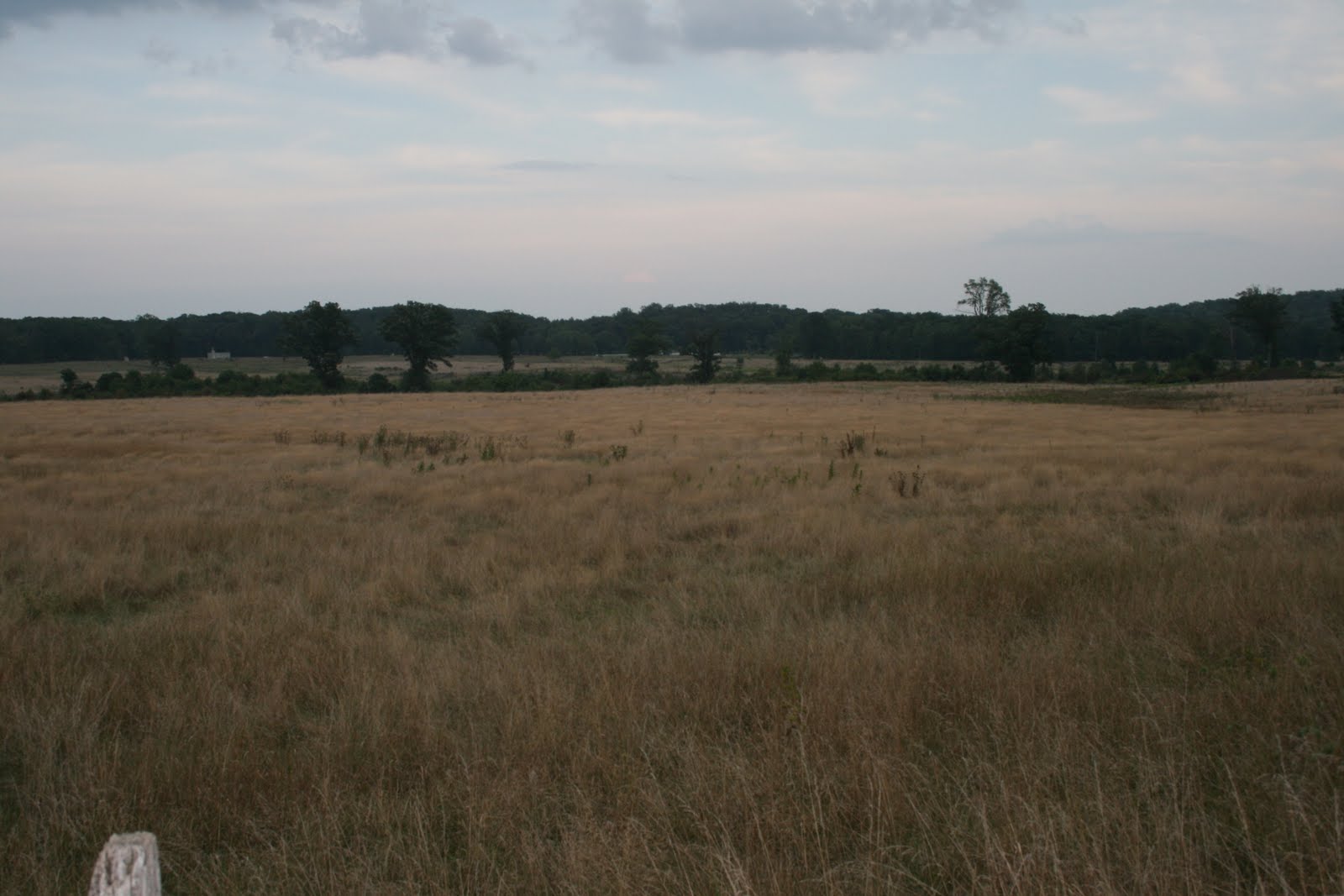
Googlemaps show that a straight line from Marianna to Gettysburg is 770 miles.  Surprisingly, Gettysburg is slightly further than even Chambersburg, making Seminary Ridge the greatest distance Marianna men in the 2nd and 8th Florida regiments traveled from home during the War.   After spending the first day marching east along the Chambersburg Pike, the Florida brigade was  not involved in that day's action.  They were deployed to an area along Seminary Ridge around the Spangler farm.  


Looking north along Seminary Ridge from the Spangler farmhouse where the Florida brigade was initially positioned.

The view east toward Cemetery Ridge from the fields just north of the Spangler Farmhouse.  The Florida Brigade more or less traveled this route toward objectives on the right portion of this image (toward the Pennsylvania monument's whose white dome if just visible on the right).

 View from the Emmitsburg road toward Cemetery Ridge where the Florida Brigade drove back the 1st & 11th MA and 26 PA regiments on the 2nd Day.  In the middle, stretching to the right, are the trees of the Codori Thicket shading Plum Run, where the Floridians were repulsed on the 3rd Day

 View from Cemetery Ridge toward the Codori Thicket where Vermont troops drove back the Floridians .

 View from Cemetery Ridge toward Seminary Ridge

Looking south west from Cemetery Ridge toward the Codori Thicket in the direction of the route taken by the 14th and 16th VT in driving into the Floridians' left. 

View across fields from swale east of Seminary Ridge with the Codori farmhouse's cupolas barely visible. The Floridians approached Cemetery Ridge by moving to the right (south) of the Corodi farmhouse on both the 2nd and 3rd day.

 View from Seminary Ridge toward Cemetery Ridge


Looking back toward the launching point near at Seminary Ridge around the Spangler Farm. 

I was intending to walk the route of both days' advances, but rapidly approaching thunder clouds dissuaded me from risking lighting and becoming the last casualty of Pickett's charge.  Hopefully I'll have better weather (and better maps) for the next visit to complete this exploration.

Friday, August 05, 2011

More Letterheads and Stationery

[Coker invoice courtesy of Joe Rubinfine]


Wednesday, August 03, 2011

Old Jackson County Stationery and Letterheads...

From the Florida Confederate Pension Files.  I'll be adding more as I find these. 


Monday, July 25, 2011

Jews of Jackson County: Part VI - Julius Solomon and the Jacoby Family

      In addition to the Fleishman, Brash and Edrehi families, two more Jewish families settled in Jackson County during the 19th century. Julius Solomon, German born, first appears in the 1880Census  listed as a 23 year old retailer living with a brother G. Solomon, about five years younger, next door to James P. Coker, of all people. Five years later, Julius is living alone. At the same time, at least two more Solomon families appear in Jackson County, both headed by men claiming German born fathers, although with American born mothers and spouses. There is no indication that these Solomon families are Jewish. In fact, C. Davis Turner does not mention any Solomons, including Julius, in his chronology of the panhandle Jewish presence. [“JG Solomon,” a farmer, also lived with a German-born sister, Molly. Molly and JG’s American-born widow, Eva, still lived in Jackson County in the same household twenty year later with Eva’s four children.] Shofner mentions Julius Solomon as operating a dry goods store in Marianna in the 1880s. Evidence of Solomon’s connection with Marianna’s Jews, admittedly scanty, includes a newspaper item that finds him traveling with Henry Brash to Columbus, Georgia [Columbus Daily Enquirer, Jan. 28, 1880]. Julius left Marianna around the turn of the century after about twenty years in the community. He was a well-known and affable traveling salesman, familiar throughout the Panhandle and gained a reputation as a political pundit.

       The last of Jackson County’s 19th century Jewish families, were the Jacoby’s. Mitch Jacoby (b. 1855), his wife Bertha (b. 1862), both born in America of German born fathers, and daughter Liliian (b. 1892) arrived in Jackson County in the mid-1890s. Jacoby operated a tavern, sold liquor in various places in the county, and advertised widely in the newspapers with good-humored ads. His congeniality is hinted at in the following passage: “Mr Mitch Jacoby of Marianna was a pleasant caller at our office last Friday, he was full of politics and good natured as always ” [Chipley Banner April 15, 1900]. About 1902, Jacoby was elected as a Jackson County representative to the state legislature where he served one term. The Jacoby family, however, did not stay long in Jackson County, moving to Pensacola around 1905, where he was described as a “well known and popular citizen.” Mitch died in 1913 and Bertha in 1927. Upon Mitch Jacoby’s death a Pensacola newspaper recalled that “his jovial and kindly nature caused him to be liked by everyone with whom he was acquainted. He was popular with the masses and took a great interest in politics, working in every campaign for the election of his friends and never giving up hope until the last ballot was counted.” [Pensacola Journal , Aug. 13, 1913 from http://familytreemaker.genealogy.com/users/j/a/c/Henry-Jacoby/WEBSITE-0001/UHP-0041.html ].

      The departure of Mitch, Bertha and Lillian Jacoby ended the continuous presence of Jewish families in Jackson County that began nearly fifty years earlier when Samuel Fleishman brought his bride, Sophia, to Marianna. The only long-time Jewish residents remaining in Jackson County after 1905 were widower Solomon Brash and Estelle (Edrehi) Alderman, who had embraced Christianity by this time. According to C. Davis Turner, no more Jewish families took root into Jackson County until the 1920s.