1868 (January through June)
Hamilton left Jackson County in January 1868 and was succeeded by Purman. Purman had become deeply involved in Florida politics, spent much time out of the area, and left the Bureau in the summer after being elected to the state senate. At the beginning of the year, Purman observed that “a stronger spirit of hostility exists against the colored people to-day than ever before” and attributed that hostility to the freedmen’s “immovable position on Republican principles.” 1868 finds the first mention of the KKK. Purman’s replacement, John Dickinson, didn’t dwell on violent incidents in his reports. The following year, of course, assassination and mayhem would overwhelm the county and Dickinson would provide the most detailed eyewtiness report.
JANUARY
In the vicinity of Greenwood, Mr. Grey refused to deliver up a colored child, on the order of the Bureau “to its rightful guardians, and expelling with the flourish of firearms the holder of the order from the premises. Enraged at this treatment of his authorized demand, the freedman collected a band of half-a-dozen armed followers, and proceeding to the house of Mr. Grey obtained possession of the child without the exercise of any violence but of course by the force of the menace.” (WJP to AHJ, 1/4/68)
APRIL
Purman writes that the KKK has sent him“several very unfriendly notices” and that from assassination “no one is protected save by an overruling Providence.” (WJP to AHJ 4/30/68)
MAY
U.S. 7th Inf. troops leave Marianna (Marianna Courier in Weekly Floridian 5/19/68)
May 22nd, “Mr E. W. Mooring, a limb of the “chivalry”, and a man of hot and rebellious character, was met on the public sidewalk by a colored woman who accidentally in passing brushed his knee with her hoopskirt, whereupon this valorous male struck her two severe blows in her face, and raved about like a madman. A high excitement was instantly produced in the colored community, and after much difficulty in finding a Justice of the Peace, which petty functionary was at last found in the outskirts of the county, Mr. Mooring was arrested for assault and battery. After a shameful and malicious judicial farce for two days before a nincompoop of a country squire, he was adjudged not guilty, and was accordingly not committed for trial before Court.”
May 23rd,: REDDICK BLUNT freedman, was killed near Marianna. Blunt “was under arrest for hog-stealing, and while in the custody of Constable Street and two colored assistants, for conveyance to the country jail, it is said he attempted to escape, and ran about half-a-mile from the road, through a heavy thicket in the woods, where he was overtaken and killed by a two charges from a shot-gun, in the right breast. A peculiar feature in this case is, that Constable Street made no pursuit at all, but remained in the road, while the colored assistants alone gave chase, and one only a short distance, while the third who was alone and shot the prisoner in the front part of the body, was a brother of the woman from whom the hog was stolen …this murder was unnecessary and unjustifiable.”
“Murder, homicide and assassination have long been so common in the experience of this section of the country, that their terrible occurrence scarely rises to the importance of a subject for sober conversation, and instead of producing horror and indignation in the moral faculties of the community, it excites only reckless comments and a fashionable spirit of bravado.” (WJP to AHJ, 5/30/68)
JUNE
June 4th: “Lot Wood, a vagabond whiteman, assaulted with a knife and ripped out the entrails of JAMES DONALD, an old freedman. There was no open provocation for this murderous deed, and the old man died in a week afterwards. Wood has escaped, and is skulking in the piney woods on the borders of the State.”
In Washington County: “Upon the vague and even unreasonable suspicion that James Bellamy, a freedboy, stole $75, he was carried out on the bay where he was tied to an anchor and plunged into the water for the purpose of extorting a confession of guilt from him, and in spite of all his frightful and prayerful asservations he was taken at 12 o’clock at night into the woods and hung to a tree, though all the while asserting his innocence, until at last half dead with fright and suffering, he was released to find his way back in the darkness as well as he could.”
“On the plantation of John Pitts, near Marianna, three colored women were wounded with fine bird shot, for the offense of merely drawing water from the well after being ordered to desist, while this same well always supplied the premises and quarters with water, and is the only one in the vicinity. One woman was quite severely wounded. All this was done for the unjust purpose of driving the hands off the plantation, in which attempt the Bureau several times restrained the employer.” (WJP to AHJ, 6/30/68)
Saturday, July 22, 2006


Thursday, July 20, 2006
CHRONICLE OF JACKSON COUNTY, FL RACIAL VIOLENCE, PART III: 1867
1867
The murder rate remained low in 1867 though incidents of violence and intimidation increased. The Hamilton and Purman complained repeatedly that the planters missed no opportunity to swindle their freedmen laborers by discharging them for petty offenses prior to the distribution of the crop share and by encouraging them to run up their store credit accounts at the plantation and with merchants who colluded with the planters. The Agents believed that, as Reconstruction policy progressed, the whites were becoming more “desperate and reckless.” They particularly complained of the influence of Georgia politician Benjamin H. Hill on Jackson County’s whites.
FEBRUARY
GILBERT WALKER (freedman) was murdered near Marianna on Feb. 2, 1867 by Hugh Parker (white). “Gilbert, engaged in hauling lumber, met a Mr. Bell driving an empty one oxcart in the public road, both gave way, but the road being narrow, and Gilbert heavily loaded, sufficient space to pass could not be given, and both stoped. Gilbert got down and held aside some bushes to permit Bell to pass – which he did. At this juncture Parker came up, on foot, and demanded of Gilbert why he did not turn out of the road. Gilbert replied that he did as far as he could. Parker retorted “If you ever do that again I’ll kill you”- and cursing him, added “I might as well do it now”- and put a revolver to his breast and shot him – Gilbert expired in fifteen minutes. Efforts were, at the time, and have since been made to arrest the murderer, but he still at large.” (CMH to ECW 2/28/67)
Hamilton and Purman visited Campbellton for the purpose of supervising labor contracts. “In the morning a few of the best citizens were present, but towards noon all of this ilk quietly disappeared off the ___, and a crowd of roughs had full sway. Whiskey was guzzled down in abundance to get up steam to assault the “Yankees”, and a mob of a dozen drunken, cowardly wretches, with revolvers buckled round them came into our room, criticizing and insulting us in the most provoking manner. Our only protection was in our revolvers laying on the table before us. They retired, came again, repeating this manoeuvre several times, when we were entreated by our colored friends to leave the town as quickly as possible, which in our unprotected condition we thought expedient to do, and did, in an open manner, with our revolvers in our hands, surrounded by a small-band of noble freedmen.” (WJP to ECW, 2/28/67) .
MARCH
Brutal murder, by beating, of freedman EPHRAIM BUCK. The freedpeople were afraid to give information “for fear of bringing down the vengeance of the murderers, & their friends upon themselves. It seems that Ephraim had been accused of stealing, and that afterwards he was seen upon Selmans (?) premises, and that Selman & McLernand – two men of notoriety – caught, abused and beat him that he died.” (CMH to AH Jackson, 3/31/67)
MAY
“George W. Melvin (white) was tried before the Circuit Court of this District held at this place during the month, charged with the murder of ELAIS HAMMOND (white) and convicted of manslaughter. Archy Hunter(?) (cold.) for rape upon the person of _____ Smith (cold) & acquitted; and Louis White (cold) for rape upon Sarah Bryant (white) & acquitted. Louis and Henderson White brothers, were charged with the commission in conjunction, of this fell deed, in Sept. last. Henderson, a boy of 15 years, was tried before the same tribunal last Fall (case then reported) was convicted, and executed by hanging, on 2 March last. He had a fair trial.”
On May 6th, “Joe and Frank Register, and Tip Skippee (white) outrageously maltreated a colored man (Chas. Russ) living near Vernon, Washington Co. It is said that this freedman who sustains a good character, I am told, - entered the room of a white woman where he was working, who reported the fact to the above mentioned boys, whereupon they took him (Charles) down into the swamp, hard by, and gave him two hundred lashes, and left him quite dead, in the swamp. Judge Bush acted promptly in the matter having the culprits arrested and bound over for their appearance at the next term of the court in that Co.”
On May 25th, Joe Moreton (white) of Campbellton assaulted, knife in hand, Franklin Hovey (cold.) with intent to kill, cutting him in several places slightly.” Moreton was arrested but immediately released upon bail.
Assailant approaches Hamilton with a knife in Washington County. Flower desecration incident at the Marianna cemetery. See Weinfeld FHQ article on Charles Hamilton for details (CMH to General, 5/31/67)
JULY
Appearance of B.H. Hill. White friends of the Bureau Agents insulted daily on the streets of Marianna. Another apparent attempt on Hamilton’s life in Campbellton.
A Mr. Teat, living on the Apalachicola river, in Calhoun Co., reported for driving three laborers from his premises and turning their families out of doors, and threatening to shoot them if they ever put foot upon his place again. The laborers were working for a third of the crop, and claimed that it was Teat’s object to deprive them of their share.
Teat’s neighbor, Mr. B. Baker, reported for having beaten a black girl with a club.
(CMH to AJH, 7/31/67)
AUGUST
Hamilton is instructed to investigate the location of the murder of DAN WEBSTER, a black boy, along the Chattahoochee River. (AHJ to CMH 8/7/67)
SEPTEMBER
On 9/27 evening “Archibald Hunter, a freedman of bad character, committed a violent rape upon a white woman, Miss Sophronia Bell, while she was proceeding to her home. It seems to be a most aggravated case, and the felon so far has eluded all pursuit.” (WJP to AHJ 9/30/67)
OCTOBER
Harassment of Republican southern whites continues. Blacks receive disproportionate fines for minor offenses (“the white man is fined five and the black man fifty dollars for the same offense”). Vandalism of Hamilton and Fleishman property. (CMH to AJH 10/31/67)
DECEMBER
Small group of soldiers dispatched by Hamilton to help freedmen collect their crop shares is driven off from several farms at gun point.
Two murders occurred during the month – all white. Silas Gladden shot one FULLERTON near Greenwood. Collet shot & killed DICKSON & Dickson’s brother avenged his death by killing COLLET. Both Gladden and Dickson escaped.
Whites are well-armed: “every man and boy in the county I am told carries his revolver and knife, and the civil authorities (there are none but the sheriff & his deputy – and the Judge of the Co. Criminal Court, & several justices – all the rest have resigned, or refuse to act) do not discharge their duties, either from fear, or from sympathy with the rebels.”
William Coker “a hot-headed youth of this place committed an assault & battery with intent to kill upon Robert Dickson, freedman, without the shadow of provocation. I directed the Deputy Sheriff R.N. Pitman to arrest him, but he has failed to do it. This man Coker, with a crowd of others of the same stripe have been raising little disturbances for some time past. This is the crowd I have every reason to believe that shaved my horses, and disfigured Mr. Fleishman’s buggies.” (CMH to AJH 12/31/67)
On Dec. 6, at Greenwood, NORMAN HALL stabbed JOHN COULLIETTE “with a knife, and a small .. the latter, seeing the use of the weapon.. his father, inflicted a like wound on Hall. Both the wounded men died.” GA Weekly Telegraph, 12/13/67 citing Marianna Courier.
The murder rate remained low in 1867 though incidents of violence and intimidation increased. The Hamilton and Purman complained repeatedly that the planters missed no opportunity to swindle their freedmen laborers by discharging them for petty offenses prior to the distribution of the crop share and by encouraging them to run up their store credit accounts at the plantation and with merchants who colluded with the planters. The Agents believed that, as Reconstruction policy progressed, the whites were becoming more “desperate and reckless.” They particularly complained of the influence of Georgia politician Benjamin H. Hill on Jackson County’s whites.
FEBRUARY
GILBERT WALKER (freedman) was murdered near Marianna on Feb. 2, 1867 by Hugh Parker (white). “Gilbert, engaged in hauling lumber, met a Mr. Bell driving an empty one oxcart in the public road, both gave way, but the road being narrow, and Gilbert heavily loaded, sufficient space to pass could not be given, and both stoped. Gilbert got down and held aside some bushes to permit Bell to pass – which he did. At this juncture Parker came up, on foot, and demanded of Gilbert why he did not turn out of the road. Gilbert replied that he did as far as he could. Parker retorted “If you ever do that again I’ll kill you”- and cursing him, added “I might as well do it now”- and put a revolver to his breast and shot him – Gilbert expired in fifteen minutes. Efforts were, at the time, and have since been made to arrest the murderer, but he still at large.” (CMH to ECW 2/28/67)
Hamilton and Purman visited Campbellton for the purpose of supervising labor contracts. “In the morning a few of the best citizens were present, but towards noon all of this ilk quietly disappeared off the ___, and a crowd of roughs had full sway. Whiskey was guzzled down in abundance to get up steam to assault the “Yankees”, and a mob of a dozen drunken, cowardly wretches, with revolvers buckled round them came into our room, criticizing and insulting us in the most provoking manner. Our only protection was in our revolvers laying on the table before us. They retired, came again, repeating this manoeuvre several times, when we were entreated by our colored friends to leave the town as quickly as possible, which in our unprotected condition we thought expedient to do, and did, in an open manner, with our revolvers in our hands, surrounded by a small-band of noble freedmen.” (WJP to ECW, 2/28/67) .
MARCH
Brutal murder, by beating, of freedman EPHRAIM BUCK. The freedpeople were afraid to give information “for fear of bringing down the vengeance of the murderers, & their friends upon themselves. It seems that Ephraim had been accused of stealing, and that afterwards he was seen upon Selmans (?) premises, and that Selman & McLernand – two men of notoriety – caught, abused and beat him that he died.” (CMH to AH Jackson, 3/31/67)
MAY
“George W. Melvin (white) was tried before the Circuit Court of this District held at this place during the month, charged with the murder of ELAIS HAMMOND (white) and convicted of manslaughter. Archy Hunter(?) (cold.) for rape upon the person of _____ Smith (cold) & acquitted; and Louis White (cold) for rape upon Sarah Bryant (white) & acquitted. Louis and Henderson White brothers, were charged with the commission in conjunction, of this fell deed, in Sept. last. Henderson, a boy of 15 years, was tried before the same tribunal last Fall (case then reported) was convicted, and executed by hanging, on 2 March last. He had a fair trial.”
On May 6th, “Joe and Frank Register, and Tip Skippee (white) outrageously maltreated a colored man (Chas. Russ) living near Vernon, Washington Co. It is said that this freedman who sustains a good character, I am told, - entered the room of a white woman where he was working, who reported the fact to the above mentioned boys, whereupon they took him (Charles) down into the swamp, hard by, and gave him two hundred lashes, and left him quite dead, in the swamp. Judge Bush acted promptly in the matter having the culprits arrested and bound over for their appearance at the next term of the court in that Co.”
On May 25th, Joe Moreton (white) of Campbellton assaulted, knife in hand, Franklin Hovey (cold.) with intent to kill, cutting him in several places slightly.” Moreton was arrested but immediately released upon bail.
Assailant approaches Hamilton with a knife in Washington County. Flower desecration incident at the Marianna cemetery. See Weinfeld FHQ article on Charles Hamilton for details (CMH to General, 5/31/67)
JULY
Appearance of B.H. Hill. White friends of the Bureau Agents insulted daily on the streets of Marianna. Another apparent attempt on Hamilton’s life in Campbellton.
A Mr. Teat, living on the Apalachicola river, in Calhoun Co., reported for driving three laborers from his premises and turning their families out of doors, and threatening to shoot them if they ever put foot upon his place again. The laborers were working for a third of the crop, and claimed that it was Teat’s object to deprive them of their share.
Teat’s neighbor, Mr. B. Baker, reported for having beaten a black girl with a club.
(CMH to AJH, 7/31/67)
AUGUST
Hamilton is instructed to investigate the location of the murder of DAN WEBSTER, a black boy, along the Chattahoochee River. (AHJ to CMH 8/7/67)
SEPTEMBER
On 9/27 evening “Archibald Hunter, a freedman of bad character, committed a violent rape upon a white woman, Miss Sophronia Bell, while she was proceeding to her home. It seems to be a most aggravated case, and the felon so far has eluded all pursuit.” (WJP to AHJ 9/30/67)
OCTOBER
Harassment of Republican southern whites continues. Blacks receive disproportionate fines for minor offenses (“the white man is fined five and the black man fifty dollars for the same offense”). Vandalism of Hamilton and Fleishman property. (CMH to AJH 10/31/67)
DECEMBER
Small group of soldiers dispatched by Hamilton to help freedmen collect their crop shares is driven off from several farms at gun point.
Two murders occurred during the month – all white. Silas Gladden shot one FULLERTON near Greenwood. Collet shot & killed DICKSON & Dickson’s brother avenged his death by killing COLLET. Both Gladden and Dickson escaped.
Whites are well-armed: “every man and boy in the county I am told carries his revolver and knife, and the civil authorities (there are none but the sheriff & his deputy – and the Judge of the Co. Criminal Court, & several justices – all the rest have resigned, or refuse to act) do not discharge their duties, either from fear, or from sympathy with the rebels.”
William Coker “a hot-headed youth of this place committed an assault & battery with intent to kill upon Robert Dickson, freedman, without the shadow of provocation. I directed the Deputy Sheriff R.N. Pitman to arrest him, but he has failed to do it. This man Coker, with a crowd of others of the same stripe have been raising little disturbances for some time past. This is the crowd I have every reason to believe that shaved my horses, and disfigured Mr. Fleishman’s buggies.” (CMH to AJH 12/31/67)
On Dec. 6, at Greenwood, NORMAN HALL stabbed JOHN COULLIETTE “with a knife, and a small .. the latter, seeing the use of the weapon.. his father, inflicted a like wound on Hall. Both the wounded men died.” GA Weekly Telegraph, 12/13/67 citing Marianna Courier.
Wednesday, July 19, 2006
CHRONICLE OF JACKSON COUNTY, FL RACIAL VIOLENCE, PART II: 1866
1866
Hamilton and Purman report only two murders, but white perpetrated violence is on the rise and increasingly organized. The local judiciary is firmly established as an agent of white domination and black subjugation.
FEBRUARY
Immediately upon Charles Hamilton’s arrival in Marianna, he observed the harassment of the white school teacher at the Freedman’s Bureau school in Marianna.
George Brammer (white), “the teacher here [Marianna] is frequently annoyed” and was “harassed by 4 young men threatening to arrest him.”
John Bate (white) of Jackson Co. “struck a freedwoman laborer in the face with a stick and ordered the freedwoman’s mother, Lucinda Poges [?] to correct her daughter for her insolence.” Lucinda protested. When Lucinda attempted to prevent Bate’s wife from throwing her possessions out of the house, “Bate’s son struck her on the arm, Bate struck her on the head and the dog bit her, hurting her severely.” Bate turned the family, husband, wife and child out of his plantation (CMH to TWO 2/28/66). Bate and his son were tried for assault and battery before the county criminal court. The son was acquitted and, Bate was fined five cents and costs. A month later Lucinda had still not recovered from her injuries. (CMH to JL McHenry, March 31, 66)
APRIL
Attacks on the Freedmen’s School in Marianna continued, but this time the freedmen began to show evidence that they were organizing themselves and standing up to the intimidation:
“The night school has been frequently disturbed. Report of mob calling out Brammer from the school house, menacing him with four revolvers and expressions of shooting him if he not promise to quite the place and close the school. The Freedman came promptly to his aid and the mob dispersed.”
“About the 18 or 19 of April: This same mob threatened to destroy the school that night, and the freedmen hearing this, assembled for self-defense. Not less than forty
colored men armed to protect themselves; but the preparations becoming known to the respectable rowdies, they only maneuvered about in small squads, and were wise enough to avoid a collision.” (CMH to JLMcHenry, 4/30/66)
MAY
Hamilton and Purman receive reports of “abuse, imposition, and assault and battery, on freedmen.” Certain whites are “too ready to inflict the most shameful treatment on the least whim or custom, or provocation whatever.” A particular source of tension is the continuing practice of white employers punishing freedman children, “which punishment, it is reasonable to believe is often cruel and unnecessary.”
Violent opposition in Greenwood and Campbellton to establishment of Freedman’s schools is so intense “that no teacher is willing to brave their fury in opening a school.” (WJP to CMH 5/31/66)
JUNE
Whites object to reports of upcoming celebration by freedmen to commemorate July 4th.
“Curses were showered upon the Bureau and freed-men, - swearing that they would shoot the men who carried the pictures and the flag, and, vi et armis, oppose the celebration.”
(CMH to JLM 6/30/66) [Celebration passed off peacefully].
JULY
Harassment of Freedmen by local law enforcement and supported by the judiciary is by now in full effect:
“Civil authorities are too prone to arrest the freed people for trivial offenses and petty ‘crimes.’ They do not certainly enjoy the privileges or liberties extended to the white citizens. They have no conscience against arresting and fining the freed-people to the full extent of the law for petty offenses against the State or individuals, and looking over them if committed by “my people.” I do not say that in doing this the Authorities transgress the law, or overstept it, - but I do say that partiality is shown. The freedpeople are sometimes fined excessively, from which the county treasury is replenished – and yet they to not get the benefit of the funds – especially the poor funds.” (CMH to JLM 7/31/66)
SEPTEMBER
Practice of requiring pre-payment of all court fees “is an effectual, impediment in the way of prosecutions for assault and battery on freedpeople, while cases of this character are becoming more numerous and aggravated.” “A disposition prevails among these petty magistrates and the people of their respective communities, to colleague and prevent as far as possible all prosecutions against white persons . . . and to watch every freedman with a lynx-eyed scrutiny, and on the slightest pretext arraign him before the authorities, and visit him with the extremest penalty of the law.”
An assault and battery was committed on Mary Jane Baker (freedwoman) by William. Parker (white). Justice Hughes refused to issue a warrant until the fee of six dollars should be prepaid. In about ten days, having raised the money, Baker applied again, when, on pre-payment, the warrant was issued. Parker was arrested, tried and fined $5.00.
The wife of Robert Cody (freedman) was beaten and assaulted and he was driven violently from the plantation of his employer, Cullin Curl without justifiable cause. When Cody sought redress, Judge Milton of the Criminal Court held the Freedmen’s Bureau approved contract invalid and Cody “became involved in twenty five dollars cost.” (WJP to CMH 9/29/66)
From the Columbus Daily Enquirer: "A difficulty occurred betwenn Wash. Melvin and ELIAS HAMMOND, about twelve miles west of Marianna, Fla., in which several shots were exchanged. Hammond was wounded in the thigh, of which he died a few days after. Melvin had two of his fingers shot off and his arm badly injured. Have no heard the cause of the quarrel." [9/18/66]
DECEMBER
Many cases of mal-treatment & shameful abuses…Assault & Battery – almost always without provocation – is frequent.”
TWO FREEDMEN are reported to have been way-laid and killed in this county, within the month. One was shot walking in the public road – the other while hunting in the woods, near Campbellton. No arrests made. (CMH to EC Woodruff, 12/31/66)
Dr. Ethelred Philips of Marianna reported that one of the men murdered had been ambushed by planters who suspected him of stealing corn. (E. Philips to J. Philips, 12/19/66)
Hamilton and Purman report only two murders, but white perpetrated violence is on the rise and increasingly organized. The local judiciary is firmly established as an agent of white domination and black subjugation.
FEBRUARY
Immediately upon Charles Hamilton’s arrival in Marianna, he observed the harassment of the white school teacher at the Freedman’s Bureau school in Marianna.
George Brammer (white), “the teacher here [Marianna] is frequently annoyed” and was “harassed by 4 young men threatening to arrest him.”
John Bate (white) of Jackson Co. “struck a freedwoman laborer in the face with a stick and ordered the freedwoman’s mother, Lucinda Poges [?] to correct her daughter for her insolence.” Lucinda protested. When Lucinda attempted to prevent Bate’s wife from throwing her possessions out of the house, “Bate’s son struck her on the arm, Bate struck her on the head and the dog bit her, hurting her severely.” Bate turned the family, husband, wife and child out of his plantation (CMH to TWO 2/28/66). Bate and his son were tried for assault and battery before the county criminal court. The son was acquitted and, Bate was fined five cents and costs. A month later Lucinda had still not recovered from her injuries. (CMH to JL McHenry, March 31, 66)
APRIL
Attacks on the Freedmen’s School in Marianna continued, but this time the freedmen began to show evidence that they were organizing themselves and standing up to the intimidation:
“The night school has been frequently disturbed. Report of mob calling out Brammer from the school house, menacing him with four revolvers and expressions of shooting him if he not promise to quite the place and close the school. The Freedman came promptly to his aid and the mob dispersed.”
“About the 18 or 19 of April: This same mob threatened to destroy the school that night, and the freedmen hearing this, assembled for self-defense. Not less than forty
colored men armed to protect themselves; but the preparations becoming known to the respectable rowdies, they only maneuvered about in small squads, and were wise enough to avoid a collision.” (CMH to JLMcHenry, 4/30/66)
MAY
Hamilton and Purman receive reports of “abuse, imposition, and assault and battery, on freedmen.” Certain whites are “too ready to inflict the most shameful treatment on the least whim or custom, or provocation whatever.” A particular source of tension is the continuing practice of white employers punishing freedman children, “which punishment, it is reasonable to believe is often cruel and unnecessary.”
Violent opposition in Greenwood and Campbellton to establishment of Freedman’s schools is so intense “that no teacher is willing to brave their fury in opening a school.” (WJP to CMH 5/31/66)
JUNE
Whites object to reports of upcoming celebration by freedmen to commemorate July 4th.
“Curses were showered upon the Bureau and freed-men, - swearing that they would shoot the men who carried the pictures and the flag, and, vi et armis, oppose the celebration.”
(CMH to JLM 6/30/66) [Celebration passed off peacefully].
JULY
Harassment of Freedmen by local law enforcement and supported by the judiciary is by now in full effect:
“Civil authorities are too prone to arrest the freed people for trivial offenses and petty ‘crimes.’ They do not certainly enjoy the privileges or liberties extended to the white citizens. They have no conscience against arresting and fining the freed-people to the full extent of the law for petty offenses against the State or individuals, and looking over them if committed by “my people.” I do not say that in doing this the Authorities transgress the law, or overstept it, - but I do say that partiality is shown. The freedpeople are sometimes fined excessively, from which the county treasury is replenished – and yet they to not get the benefit of the funds – especially the poor funds.” (CMH to JLM 7/31/66)
SEPTEMBER
Practice of requiring pre-payment of all court fees “is an effectual, impediment in the way of prosecutions for assault and battery on freedpeople, while cases of this character are becoming more numerous and aggravated.” “A disposition prevails among these petty magistrates and the people of their respective communities, to colleague and prevent as far as possible all prosecutions against white persons . . . and to watch every freedman with a lynx-eyed scrutiny, and on the slightest pretext arraign him before the authorities, and visit him with the extremest penalty of the law.”
An assault and battery was committed on Mary Jane Baker (freedwoman) by William. Parker (white). Justice Hughes refused to issue a warrant until the fee of six dollars should be prepaid. In about ten days, having raised the money, Baker applied again, when, on pre-payment, the warrant was issued. Parker was arrested, tried and fined $5.00.
The wife of Robert Cody (freedman) was beaten and assaulted and he was driven violently from the plantation of his employer, Cullin Curl without justifiable cause. When Cody sought redress, Judge Milton of the Criminal Court held the Freedmen’s Bureau approved contract invalid and Cody “became involved in twenty five dollars cost.” (WJP to CMH 9/29/66)
From the Columbus Daily Enquirer: "A difficulty occurred betwenn Wash. Melvin and ELIAS HAMMOND, about twelve miles west of Marianna, Fla., in which several shots were exchanged. Hammond was wounded in the thigh, of which he died a few days after. Melvin had two of his fingers shot off and his arm badly injured. Have no heard the cause of the quarrel." [9/18/66]
DECEMBER
Many cases of mal-treatment & shameful abuses…Assault & Battery – almost always without provocation – is frequent.”
TWO FREEDMEN are reported to have been way-laid and killed in this county, within the month. One was shot walking in the public road – the other while hunting in the woods, near Campbellton. No arrests made. (CMH to EC Woodruff, 12/31/66)
Dr. Ethelred Philips of Marianna reported that one of the men murdered had been ambushed by planters who suspected him of stealing corn. (E. Philips to J. Philips, 12/19/66)
Tuesday, July 18, 2006
CHRONICLE OF JACKSON COUNTY, FL RACIAL VIOLENCE: PART I
During the War years and the first year of Reconstruction, racial killings were rare events in Jackson County, Florida. Charles Hamilton was asked to compile a list of murders occuring since the war began:
1861
4/13/1861: JOE, a “slave” murdered. John D. Padget (white) of Jackson Co. was tried in October 1866 for the murder and acquitted.
1863
2/13/1863: RUBEN, a “slave” was murdered in Calhoun Co. Fla. on the 13th of Feb. 1863, by Luke Lot (white). Lot was tried in the Circuit Court of the West Dist. of Fla., Judge Bush presiding, on the 2nd May 1866, verdict “not guilty” [NOTE: Luke Lot became a legendary figure of white resistance in the Florida, Georgia, Alabama border country during Reconstruction. Dale Cox suggests that Lot may have been instrumental in organizing the white community during the “Jackson County War”].
Spring 1863: (1) A negro was killed (shot), and (2) body of one drowned found in the Chipola River near the Natural Bridge, Jackson Co. “Their names, or the circumstances could not be ascertained. They were said to be ‘runaways.’”
1865
12/13/65: WYLIE “freedman, was whipped to death …in Marianna, by Ashley B. Hamilton” (white) of Jackson Co. Hamiton was arrested and sent to Tallahassee under guard but escaped “at the Arsenal” (Chattachoochee?). Hamilton was tried in the Circuit Court at Marianna on October 18, 1863 (same trial as Padget) “and the jury returned a verdict of ‘not guilty.’”
“As far as I can ascertain no murders have been committed by Freedmen since the commencement of the War, in this District, all of which is respectfully submitted.”
(CMH to J Lyman, 10/24/66)
1861
4/13/1861: JOE, a “slave” murdered. John D. Padget (white) of Jackson Co. was tried in October 1866 for the murder and acquitted.
1863
2/13/1863: RUBEN, a “slave” was murdered in Calhoun Co. Fla. on the 13th of Feb. 1863, by Luke Lot (white). Lot was tried in the Circuit Court of the West Dist. of Fla., Judge Bush presiding, on the 2nd May 1866, verdict “not guilty” [NOTE: Luke Lot became a legendary figure of white resistance in the Florida, Georgia, Alabama border country during Reconstruction. Dale Cox suggests that Lot may have been instrumental in organizing the white community during the “Jackson County War”].
Spring 1863: (1) A negro was killed (shot), and (2) body of one drowned found in the Chipola River near the Natural Bridge, Jackson Co. “Their names, or the circumstances could not be ascertained. They were said to be ‘runaways.’”
1865
12/13/65: WYLIE “freedman, was whipped to death …in Marianna, by Ashley B. Hamilton” (white) of Jackson Co. Hamiton was arrested and sent to Tallahassee under guard but escaped “at the Arsenal” (Chattachoochee?). Hamilton was tried in the Circuit Court at Marianna on October 18, 1863 (same trial as Padget) “and the jury returned a verdict of ‘not guilty.’”
“As far as I can ascertain no murders have been committed by Freedmen since the commencement of the War, in this District, all of which is respectfully submitted.”
(CMH to J Lyman, 10/24/66)
Sunday, July 16, 2006
Updates to come
I haven't forgotten this blog. Instead, I've been consumed by other matters such as editing my transcriptions of Charles Hamilton's Freedmen's Bureau reports. I'm not sure what to do with these documents. The file is too large to conveniently place on the blog. If anyone readers are interested in more information about the reports of the Freedmen's Bureau officers of Jackson County, Florida from 1866 to 1868 (Hamilton, Purman and Dickinson), feel free to contact me.
Saturday, June 17, 2006
Finally: the Charles Hamilton article is in print
"'More Courage Than Discretion': Charles M. Hamilton in Reconstruction Era Florida" appears in the Florida Historical Quarterly, Volume 84, Number 4, Spring 2006. Copies are available from the Florida Historical Society at
http://www.florida-historical-soc.org
http://www.florida-historical-soc.org
Sunday, June 11, 2006
Abraham Coles Osborn, D.D., L.L.D.: The Biography

The Eagle offers the following description: "He is about 35 years of age [May 1871], five feet ten inches in height, rather light build, has a fair complexion, brown hair, and dark blue eyes, a sandy moustache, and a large mouth. Otherwise his appearance is not striking. He dresses in plain black, and wears a black necktie. He speaks so distinctly that every word and even syllable can be heard in any part of the church, but nevertheless his voice is not pleasant, and he pronounces some words in such a peculiar way that he would sooner be taken for an Englishman or Irishman than a native of New Jersey, which he is said to be." [Brooklyn Eagle, May 15, 1871].
Abraham Coles Osborn was born in Scotch Plains, NJ (near Plainfield) on Feb. 20, 1831. Brother Thomas Ward was born two years later. In the early 1840s, the Osborn family moved to Wilna, NY, between the Adirondacks and Lake Ontario. He studied at Madison Univ. (the predecessor of Colgate Univ.), a Baptist institution, and prepared for the ministry at Hamilton Theological Seminary (later Colgate Rochester Divinity School). Osborn's first pastorate was in Louisville, KY where he was ordained "a minister of the gospel" in 1858. In June 1861 (after Fort Sumter), Osborn left for Germany where he studied for seven months. He returned to Louisville and married Miss. Sarah E. Matthews of Louisville in December 1861. A year later the Osborns moved to St. Louis where A.C. accepted the pastorate of the Fourth Baptist Church. In 1867, Osborn received the honorary degree of Doctor of Divinity from Shurtleff College (a Baptist seminary that became part of Southern Illinois University in the 1950s). Osborn's wife died in August 1868 and he spent most of 1869 touring Europe, at least partially, in the company of Senator T.W. In December, 1869 he accepted the pastorate at the Brooklyn Tabernacle church. In 1872, he married Miss. Emma Hatfield of New York (whom he had met in Paris) and, the following year, left Brooklyn for the Second Baptist Church on West 25th St. in Manhattan. In 1877, Osborn moved once again, now to North Adams MA until he accepted a pastorage in New Albion in Western, NY. In 1895, Osborn became President of Benedict College in Columbia, S.C. (a black college for the training of "teachers and preachers") where he remained until 1911. He received the degree of Doctor of Laws from Colgate in 1905 where he served as a trustee for many years. He returned to North Adams, MA where he died in 1916 at the age of 84 and was buried between Emma and T.W. Osborn was survived by three sons, Robert H., Ralph and Harold. [Obituary of A.C. Osborn from North Adams newspaper by Rev. J. Wilcox; Bio. sketch by Elizabeth Osborn Slater Hubbard]. These sources are courtesy of Mr. James Peck of Corona CA, a descendant of Spencer C. Osborn, older brother of A.C. and T.W. Mr. Peck has commented that "It seems [Osborn] spent more time in the secular world than the religious. He was a Chaplain to the wealthy and was married twice, both women from wealthy families."
Sunday, June 04, 2006
Freedmen's Tribute to William Purman
William Purman, Hamilton's boyhood neighbor and friend, resigned his War Department post in Washington and came to Marianna, Fl. in early 1866. In mid-April, after Hamilton's request, Purman was appointed the Freedmen's Bureau's civilian agent for Jackson County (Hamilton was the military officer responsible for Jackson, Washington, Calhoun and Holmes Counties). Purman was appointed "Special Agent" at Marianna at the salary of $100/month beginning in June. Technically, Purman was Hamilton's subordinate, but after a short time it became apparent that they served as equals. Hamilton's attention and time were disseminated across his geographically large jurisdiction where much of the freedmen's population was widely dispersed. Dissatisfied by civilian agents previously appointed by Osborn, Hamilton was compelled to spend time away from Jackson County riding around the other counties under his responsibility. This burden became heavier in February 1867 when the Bureau terminated the positons of civilian agents in Hamilton's territory. In mid-February, Purman was instructed to report to the Bureau's Florida headquarters for further orders and in March he was appointed Bureau Agent at Volusia City. In April, the Bureau directed Purman to investigate Ralph Ely's ill-fated freedmen's colony in New Smyrna, FL. Shortly after Purman's reassignment, Hamilton wrote to his Bureau superiors requesting the return of Purman ("an Agent of very considerable efficiency- with a heart devoted to the Freedmen’s cause") to Jackson County [Hamilton to A.H. Jackson, March 21, 1867].
Hamilton's letter was soon followed by a remarkable document delivered to Colonel John Sprague, the superior Bureau officer for Florida:
"Colonel:
Your petitioners would lay their humble request before you in this form and ask you to restore to us our good Freedmen Bureau Agent, W.J. Purman, if it is possible to do so. As you are now Head we ___ to you in confidence asking this, though we know you are doing everything for the best.
He worked day & night for our good. Starting up our education. Starting up our societies. Making speeches. Settling our Difficulties, and explaining our difficulties and settling them up for us. explaining to all through the country how to work, how to make money & how to live in peace and harmony. We feel that he has done all of us more good than any man we ever saw. The people all want him back. And therefore Colonel if you can possibly do it, We will pray and thank you for it, with our blessings on the whole Freedmens Bureau. We remain your humble petitioners."
This letter, dated March 25, 1867 was signed by 70 freedmen led by Rev. Emanuel Fortune. Well-known signers include Calvin Rogers (later constable and murdered in early 1870), Benjamin Livingston (later state legislator, county commissioner and Marianna postmaster and councilman and the last black office holder in Jackson County prior to Jim Crow's entrenchment), Jesse Robinson (later state legislator and justice of the peace), Rev. Fuller White (later county commissioner and Marianna councilman), and Isham White (county commissioner) [For biographical information, Canter Brown, Jr., Florida's Black Public Officials, 1867-1924].
Purman was dispatched in May by the Bureau on an inspection tour of West Florida and returned to Jackson County by the end of June 1867.
Hamilton's letter was soon followed by a remarkable document delivered to Colonel John Sprague, the superior Bureau officer for Florida:
"Colonel:
Your petitioners would lay their humble request before you in this form and ask you to restore to us our good Freedmen Bureau Agent, W.J. Purman, if it is possible to do so. As you are now Head we ___ to you in confidence asking this, though we know you are doing everything for the best.
He worked day & night for our good. Starting up our education. Starting up our societies. Making speeches. Settling our Difficulties, and explaining our difficulties and settling them up for us. explaining to all through the country how to work, how to make money & how to live in peace and harmony. We feel that he has done all of us more good than any man we ever saw. The people all want him back. And therefore Colonel if you can possibly do it, We will pray and thank you for it, with our blessings on the whole Freedmens Bureau. We remain your humble petitioners."
This letter, dated March 25, 1867 was signed by 70 freedmen led by Rev. Emanuel Fortune. Well-known signers include Calvin Rogers (later constable and murdered in early 1870), Benjamin Livingston (later state legislator, county commissioner and Marianna postmaster and councilman and the last black office holder in Jackson County prior to Jim Crow's entrenchment), Jesse Robinson (later state legislator and justice of the peace), Rev. Fuller White (later county commissioner and Marianna councilman), and Isham White (county commissioner) [For biographical information, Canter Brown, Jr., Florida's Black Public Officials, 1867-1924].
Purman was dispatched in May by the Bureau on an inspection tour of West Florida and returned to Jackson County by the end of June 1867.
Friday, May 26, 2006
"Generalissimo of the Ku Klux": Jimmy Coker's War Record
Col. James P. Coker was the organizer of the Jackson County white community's resistance to Republican administration and Reconstruction policy. While he was not directly implicated in the violence of the "Jackson County War," Hamilton and Purman considered him the ringleader and even, in William Purman's words, Generalissimo of the Ku Klux in Jackson County. He tormented and threatened Hamilton and Dickinson and organized the meeting that announced the expulsion of Fleishman. Coker was arrested in December 1871 for violating the Enforcement Act, tried at the United States Court at Jacksonville and the government dropped the prosecution about a year later [Peek, "Curbing Voter Intimidation in Florida, 1871" FHQ, vol. 43, April 1865]. United States v. James Coker, December 11, 1871, Box 082429. (The Enforcement Act was "aimed at outlawing any denial of the right to vote because of race, color, or previous condition of servitude. Intimidation to deprive the right to vote, conspiracy, and going abroad in disguise to prevent the free exercise of anyone's civil rights were also forbidden" - Peek, ibid).
Suprisingly, however, Coker did not have a distinguished war record. Coker died in Marianna on August 20, 1890 and his second wife, Ella, filed an application for a widow's pension from the state of Florida stating that Coker had served in Captiain John M. F. Irwin's Florida Calvary from Oct. 3 until mustered out on Oct. 11, 1862 and that he then served as "Quarter-Master and Home Guard from 1862 to 1865." The initial application was put on hold because Mrs. Coker did not furnish any evidence of Coker's "war service other than a statement from the Adjutant General that he mustered into service October 3rd, 1862, and mustered out October 11th, 1862." This did not constitute proof of war service as required by Florida's pension law. The Comptroller's office requested that Mrs. Coker provide affidavits from Coker's comrades in arms as to Coker's service.
Mrs. Coker submitted another application in 1927 stating that Coker was mustered out in1862 "to confiscate provisions and clothing and send to the front for the use and benefit of Confederate soldiers." Incredibly, Mrs. Coker presented, as her sole supporting evidence of Coker's service, the affidavit of Emanuel Spires, age 79, who had been a slave "owned by Mr. Thomas and General W. D. Barnes." Spires recalled Coker as "Confederate Government Agent to collect Food and ship to the front for the Confederate soldiers, and was known as a Contra-band Agent, for the Confederate Government." Spires seemed to remember Coker as having confiscated some wagons of food from his master's plantation and having been told by Coker that the wagons were being sent to the front. It is stunning that Jimmy Coker's widow resorted to the statement of an elderly former slave for the sole source of supporting documentation for her application for a military pension.
In 1927, the Florida Legislature apparently approved an act directing the state Pension Board to grant Mrs. Coker a pension.
[Source: Florida Confederate Pension Application Files: www.floridamemory.org].
Suprisingly, however, Coker did not have a distinguished war record. Coker died in Marianna on August 20, 1890 and his second wife, Ella, filed an application for a widow's pension from the state of Florida stating that Coker had served in Captiain John M. F. Irwin's Florida Calvary from Oct. 3 until mustered out on Oct. 11, 1862 and that he then served as "Quarter-Master and Home Guard from 1862 to 1865." The initial application was put on hold because Mrs. Coker did not furnish any evidence of Coker's "war service other than a statement from the Adjutant General that he mustered into service October 3rd, 1862, and mustered out October 11th, 1862." This did not constitute proof of war service as required by Florida's pension law. The Comptroller's office requested that Mrs. Coker provide affidavits from Coker's comrades in arms as to Coker's service.
Mrs. Coker submitted another application in 1927 stating that Coker was mustered out in1862 "to confiscate provisions and clothing and send to the front for the use and benefit of Confederate soldiers." Incredibly, Mrs. Coker presented, as her sole supporting evidence of Coker's service, the affidavit of Emanuel Spires, age 79, who had been a slave "owned by Mr. Thomas and General W. D. Barnes." Spires recalled Coker as "Confederate Government Agent to collect Food and ship to the front for the Confederate soldiers, and was known as a Contra-band Agent, for the Confederate Government." Spires seemed to remember Coker as having confiscated some wagons of food from his master's plantation and having been told by Coker that the wagons were being sent to the front. It is stunning that Jimmy Coker's widow resorted to the statement of an elderly former slave for the sole source of supporting documentation for her application for a military pension.
In 1927, the Florida Legislature apparently approved an act directing the state Pension Board to grant Mrs. Coker a pension.
[Source: Florida Confederate Pension Application Files: www.floridamemory.org].
Wednesday, May 17, 2006
More creative writing from the Floridian: Osborn's fictional rejoinder
The previous post contained an "interview" of Charles Hamilton by the Tallahassee Floridian's correspondent "Enfant Perdu." Several weeks later, Perdu reappeared (was this a monthly political humor column?) with the inevitable Osborn "rejoinder":
Interesting letter received by our Correspondent Enfant Perdu, from Hon T. W. Osborn, U. S. Senator from Florida.[Private and confidential.]U. S. SENATE CHAMBER
WASHINGTON, D. C., MAY 25, '71
DEAR ENFANT - I notice by a late copy of the Floridian, that you have interviewed Hon. C. M. Hamilton, and obtained his version in regard to the Great Southern Railroad affair, and as it contains what would seem to be an aspersion upon my political sagacity, I desire to inform you exactly where I stand, both in regard to the Southern Railroad, and the U.S Marshalship for Florida. As this letter is strictly confidential, I shall of course make it as plain and frank as possible.
Florida is my adopted state, and I have a great affection for her, which unfortunately her people do not seem to reciprocate. During my past political career I have tried to the best of my poor abilities to advance the interests of the State, (incidentally enriching myself at the same time) and I feel that I deserve some credit for my labors in this direction, for I am sensitive if I am fat.The charge is made that in connection with the railroad scheme, I sought to enrich myself and brother at the expense of the tax payers of the State; but certainly no good christian will object to that, for the book they should square themselves by says, "If any provide not for his own, especially for those of his own house, he hath denied the faith and is worse an infidel."[1] I am free to say that both myself and friends are impecunious cusses, and if our debts were paid, would scarcely have enough money left to buy a waterfall for a mosquito; and we never intended to put the road through ourselves. What we did intend, was to get all the land grants possible and then sell our franchise to some foreign corporation, which at the completion of the work would have been virtually owners of Florida, and the citizens might growl, but they would be too poor to bite.
The object of my brother, Rev. A. C. Osborn, in becoming so deeply involved in the project was a purely christian and benevolent one. He believed the people of Florida to be deep in the "gall of bitterness and bonds of iniquity,"[2] and desired to employ in the salvation of their souls the humanizing influences of a great railroad; thinking that every screech of the whistle and every puff of the engine, would admonish them of the necessity of preparing for the hereafter. His object was a noble one, and whoever casts a slur upon it deserves the horrible fate of Prometheus, who you will remember was chained to a rock for eating a vulture, that bird being considered sacred among the heathen. As for myself I am truly sorry that I ever had anything to do with it, for even the boot-blacks at the capitol, with an indifference to senatorial dignity approaching nearly to the sublime, have dubbed me "Railroad Tommy," and as I before remarked, I am sensitive if I am fat. [3]
However, I shall redeem myself I think for at the next session I intend to offer a bill, resolving that as Florida is too poor, the U. S. Government will father two magnificent projects that I now have in hand. One is to dredge out Lake Lafayette in Leon county, and make it navigable for light draft steamers, not drawing more than three feet of water, and mainly to be used for picnics, funerals, &c. The dredging is to be done by one of Hoe's largest cylinder presses (with double barreled escapement,) and to be under the supervision of E. M. Cheney, the eminent Jacksonville "gasometer," (vide New Era) who will bring to his new field of labor the greatest qualifications for the work, and no doubt give satisfaction to all parties.[4]
Project number two is one of incalculable value in a more sanitary point of view. It is nothing more nor less than to transport the famous Wakulla Springs to Jacksonville, to be used as a sanitarium by all having an "itch for office," as well as by members of the Y. M. C. A. [5] The transportation is to be accomplished by a new species of sub soiling, which I have just patented to be superintended by myself, and as it is to remain secret until fully performed, I shall only employ negroes in the work as they are best qualified to keep dark concerning it. These are the things that will make me famous, and the name of Osborn shall yet live in story "one of the few, the immortal names that were not born to die." [6]
Now in regard to the marshalship. When I saw Hamilton's name sent in to the Senate for that position, I actually trembled with dismay for you will doubtless remember that I once held the position of Register in Bankruptcy, and there might be some little technical informalities in my accounts, which only a friend should examine, so I determined that a friend of mine should be apppointed Marshal. I immediately notified Alberger to prepare and file some affidavits against Hamilton, while I hurried off to see Grant. On being admitted to the presidential palace, I explained to Ulysses my errand, and told him that if he would withdraw Hamilton's name and have Conant appointed, I would vote for the removal of Sumner, and in favor of San Domingo. He agreed to do so, and I left his presence with a happy heart. The best of the joke is, that when Hamilton called on Grant to ask an explanation he was grossly snubbed, and even refused a copy of the charges on file against him. [7]
I find that I have written a much longer letter than I intended and will now close, by carefully admonishing you to keep this letter strictly private in all respects.
Truly yours, OSBORN
ENFANT PERDU, Esq., Tallahassee, Fla.
Dear Floridian - In giving the above letter to the public, I feel that I am but fulfilling a simple duty, and that duty I shall carry out unto the bitter end, even though that end be BLOOD; and I hereby give warning that I can snuff a barn door at fifteen paces, and knock pennies off a cat's tail as fast that feline animile can histe them on. There is a subtle vein of rascality running through the honorable Senator's letter, which will no doubt strike his friends very unpleasantly, and they may blame me for having violated the confidence reposed in me; but I feel that I have a duty to perform, and like the Greek Philosopher, old Sarcophagus, I shall not allow mere personal friendship to stand in the way. I have no ill will against Mr. Osborn, but when any man, high or low, seeks to injure the State which I have taken under my protection, I shall in the sublime language of the Teutonic poet, "cry havoc, and let slip the dogs of war."[8]
ENFANT PERDU
[Tallahassee Weekly Floridian, May 30, 1871]
NOTES:
1. 1 Timothy 5:8
2. Acts 8:23. Remarkably, this Floridian satire mockingly uses the religious justification earnestly invoked by Rev. A. C. Osborn to rationalize to his congregants his serving as president of the Great Southern Railroad.
3. Uncertain reference: perhaps popular minstrel show joke?
4. Lake Lafayette was a large shallow lake in Leon County (Tallahassee area). Hoe was a manufacturer of printing presses ("cylinder press"), often quite large machines. The use of printing machines for "dredging" is absurd. E. M. Cheney was a Republican political operative active during Florida reconstruction. "Gassy" was a frequent taunt invoked by the Floridian against its Republican targets. New Era was a Gainesville newspaper.
5. Wakulla Springs are a large natural spring and popular recreation area not far from Tallahassee. Obviously, the proposed "move" to Jacksonville is absurd. The joke about the YMCA is obscure.
6. From "Marco Bozzaris" by Fitz-Greene Halleck.
7. Hamilton's nomination for marshal was stalled by the Senate Republicans and ultimately withdrawn by Grant in favor of Osborn "Ring" loyalist, Simon Conant. Also in March 1871, Charles Sumner lost his position as chair of the Senate Committee on Foreign Relations stemming, at least partially, from Sumner's opposition to Grant's plan to annex Santo Domingo. Such an alleged deal (Osborn opposing Sumner in return for Grant withdrawing Hamilton's nomination) - admittedly not alluded to anywhere else - could explain how Osborn, who had not been close to the Grant administration, could, together with New York Senator Roscoe Conkling, engineer Hamilton's humiliation with respect to the marshalship he desperately sought.
8. "Julius Caeser," (Act III, Scene 1), Shakespeare.
Interesting letter received by our Correspondent Enfant Perdu, from Hon T. W. Osborn, U. S. Senator from Florida.[Private and confidential.]U. S. SENATE CHAMBER
WASHINGTON, D. C., MAY 25, '71
DEAR ENFANT - I notice by a late copy of the Floridian, that you have interviewed Hon. C. M. Hamilton, and obtained his version in regard to the Great Southern Railroad affair, and as it contains what would seem to be an aspersion upon my political sagacity, I desire to inform you exactly where I stand, both in regard to the Southern Railroad, and the U.S Marshalship for Florida. As this letter is strictly confidential, I shall of course make it as plain and frank as possible.
Florida is my adopted state, and I have a great affection for her, which unfortunately her people do not seem to reciprocate. During my past political career I have tried to the best of my poor abilities to advance the interests of the State, (incidentally enriching myself at the same time) and I feel that I deserve some credit for my labors in this direction, for I am sensitive if I am fat.The charge is made that in connection with the railroad scheme, I sought to enrich myself and brother at the expense of the tax payers of the State; but certainly no good christian will object to that, for the book they should square themselves by says, "If any provide not for his own, especially for those of his own house, he hath denied the faith and is worse an infidel."[1] I am free to say that both myself and friends are impecunious cusses, and if our debts were paid, would scarcely have enough money left to buy a waterfall for a mosquito; and we never intended to put the road through ourselves. What we did intend, was to get all the land grants possible and then sell our franchise to some foreign corporation, which at the completion of the work would have been virtually owners of Florida, and the citizens might growl, but they would be too poor to bite.
The object of my brother, Rev. A. C. Osborn, in becoming so deeply involved in the project was a purely christian and benevolent one. He believed the people of Florida to be deep in the "gall of bitterness and bonds of iniquity,"[2] and desired to employ in the salvation of their souls the humanizing influences of a great railroad; thinking that every screech of the whistle and every puff of the engine, would admonish them of the necessity of preparing for the hereafter. His object was a noble one, and whoever casts a slur upon it deserves the horrible fate of Prometheus, who you will remember was chained to a rock for eating a vulture, that bird being considered sacred among the heathen. As for myself I am truly sorry that I ever had anything to do with it, for even the boot-blacks at the capitol, with an indifference to senatorial dignity approaching nearly to the sublime, have dubbed me "Railroad Tommy," and as I before remarked, I am sensitive if I am fat. [3]
However, I shall redeem myself I think for at the next session I intend to offer a bill, resolving that as Florida is too poor, the U. S. Government will father two magnificent projects that I now have in hand. One is to dredge out Lake Lafayette in Leon county, and make it navigable for light draft steamers, not drawing more than three feet of water, and mainly to be used for picnics, funerals, &c. The dredging is to be done by one of Hoe's largest cylinder presses (with double barreled escapement,) and to be under the supervision of E. M. Cheney, the eminent Jacksonville "gasometer," (vide New Era) who will bring to his new field of labor the greatest qualifications for the work, and no doubt give satisfaction to all parties.[4]
Project number two is one of incalculable value in a more sanitary point of view. It is nothing more nor less than to transport the famous Wakulla Springs to Jacksonville, to be used as a sanitarium by all having an "itch for office," as well as by members of the Y. M. C. A. [5] The transportation is to be accomplished by a new species of sub soiling, which I have just patented to be superintended by myself, and as it is to remain secret until fully performed, I shall only employ negroes in the work as they are best qualified to keep dark concerning it. These are the things that will make me famous, and the name of Osborn shall yet live in story "one of the few, the immortal names that were not born to die." [6]
Now in regard to the marshalship. When I saw Hamilton's name sent in to the Senate for that position, I actually trembled with dismay for you will doubtless remember that I once held the position of Register in Bankruptcy, and there might be some little technical informalities in my accounts, which only a friend should examine, so I determined that a friend of mine should be apppointed Marshal. I immediately notified Alberger to prepare and file some affidavits against Hamilton, while I hurried off to see Grant. On being admitted to the presidential palace, I explained to Ulysses my errand, and told him that if he would withdraw Hamilton's name and have Conant appointed, I would vote for the removal of Sumner, and in favor of San Domingo. He agreed to do so, and I left his presence with a happy heart. The best of the joke is, that when Hamilton called on Grant to ask an explanation he was grossly snubbed, and even refused a copy of the charges on file against him. [7]
I find that I have written a much longer letter than I intended and will now close, by carefully admonishing you to keep this letter strictly private in all respects.
Truly yours, OSBORN
ENFANT PERDU, Esq., Tallahassee, Fla.
Dear Floridian - In giving the above letter to the public, I feel that I am but fulfilling a simple duty, and that duty I shall carry out unto the bitter end, even though that end be BLOOD; and I hereby give warning that I can snuff a barn door at fifteen paces, and knock pennies off a cat's tail as fast that feline animile can histe them on. There is a subtle vein of rascality running through the honorable Senator's letter, which will no doubt strike his friends very unpleasantly, and they may blame me for having violated the confidence reposed in me; but I feel that I have a duty to perform, and like the Greek Philosopher, old Sarcophagus, I shall not allow mere personal friendship to stand in the way. I have no ill will against Mr. Osborn, but when any man, high or low, seeks to injure the State which I have taken under my protection, I shall in the sublime language of the Teutonic poet, "cry havoc, and let slip the dogs of war."[8]
ENFANT PERDU
[Tallahassee Weekly Floridian, May 30, 1871]
NOTES:
1. 1 Timothy 5:8
2. Acts 8:23. Remarkably, this Floridian satire mockingly uses the religious justification earnestly invoked by Rev. A. C. Osborn to rationalize to his congregants his serving as president of the Great Southern Railroad.
3. Uncertain reference: perhaps popular minstrel show joke?
4. Lake Lafayette was a large shallow lake in Leon County (Tallahassee area). Hoe was a manufacturer of printing presses ("cylinder press"), often quite large machines. The use of printing machines for "dredging" is absurd. E. M. Cheney was a Republican political operative active during Florida reconstruction. "Gassy" was a frequent taunt invoked by the Floridian against its Republican targets. New Era was a Gainesville newspaper.
5. Wakulla Springs are a large natural spring and popular recreation area not far from Tallahassee. Obviously, the proposed "move" to Jacksonville is absurd. The joke about the YMCA is obscure.
6. From "Marco Bozzaris" by Fitz-Greene Halleck.
7. Hamilton's nomination for marshal was stalled by the Senate Republicans and ultimately withdrawn by Grant in favor of Osborn "Ring" loyalist, Simon Conant. Also in March 1871, Charles Sumner lost his position as chair of the Senate Committee on Foreign Relations stemming, at least partially, from Sumner's opposition to Grant's plan to annex Santo Domingo. Such an alleged deal (Osborn opposing Sumner in return for Grant withdrawing Hamilton's nomination) - admittedly not alluded to anywhere else - could explain how Osborn, who had not been close to the Grant administration, could, together with New York Senator Roscoe Conkling, engineer Hamilton's humiliation with respect to the marshalship he desperately sought.
8. "Julius Caeser," (Act III, Scene 1), Shakespeare.
Tuesday, May 16, 2006
More Press Reaction to the Great Southern Railroad Scandal: Humor from the Weekly Floridian

Florida's most prominent newspaper, the Tallahassee Weekly Floridian was a staunch Democratic party organ that continuously launched vicious attacks on Florida's Republicans during Reconstruction. Long-time editor Charles E. Dyke's Floridian took special delight in the exposure of the GSRR which entangled many leading Republicans. Charles Hamilton, a frequent subject of the paper's taunts since he came to public attention in early 1868, unexpectedly found himself portrayed as a sympathetic figure for his role in bringing the GSRR scandal to light. Nevertheless, the Floridian couldn't resist mocking Hamilton and published a comic "interview" from correspondent "Enfant Perdu" that I have transcribed and annotated below. A similar comic interview with Osborn followed shortly thereafter. Photo: Charles E. Dyke, long-time publisher and editor of the Floridian (Fl. St. Archives)]:
Washington, D.C. April 17, 1871
Editors Floridian: I arrived in this city just when the so-called expose of the Great Southern Railroad Company, by Hon. C. M. Hamilton, M. C. from Florida, appeared in the columns of that spicy paper the Capital; and I resolved to seek an interview with Hamiton, and find out the exact status of affairs, in order if possible to set him right before his former constituents, and the people at large. When a man has once served a term in Congress; and then been repudiated by his constituents, it is ever afterwards hard work to find out his permanent abiding place. There is a great fascination to some about the scene of their former greatness, and they continue to hang around the city for years afterwards. Some sink lower and lower, until they become newspaper men, or engage in some other disreputable business, so you will please imagine that I had considerable trouble to find out where "Handsome Charlie"[1] obtained his daily "hash." At last I was directed to old mother Shipley's on "F" street, below the avenue, and so wended my way thither. Arriving at the house, I knocked at the door, and it was opened by a "ward of the nation," whose mouth looked like a buckwheat cake run over by a cart wheel. Being told that Col. Hamilton was in, I sent up my card, and in a few minutes a rather tall, handsome man, with blonde moustache and beard, came to the door, introduced himself to me as Chas. M. Hamilton, and invited me up stairs to his private den.[2] Arriving there, "Enfant," said he, "how does the old thing work?"
"Very dry," said I, and with that we did mutually "smile," and deposited about two inches of "bug juice" under our respective vests, lit our segars and prepared for sociable talk.
"Now Charlie," said I, "look here: how in the devil came you to make such an egregious blunder as to come out in the papers with those affidavits, letters &c.? You have ruined yourself irretrievably with your party, and placed yourself in a very unpleasant situation. Why, o why, did you do thusly?"
"Lend me your ears," said he, "and I will a plain unvarnished tale unfold."[3]
"Hold," said I, "your ears are large enough for all practical purposes; why do you want mine?"
"I was only quoting from the immortal old Billy," said he; "I meant I wanted you to listen to my plaintive story. They roused the lion in my breast by laughing at my plan in regard to the Great Southern Railroad, and adopting one of their own. If my idea had been carried out, we would each in ten years been worth $1,000,000.[4] I wanted the road to be called 'The Great Southern Zig Zag,' to start right from the steps of the Capitol at Tallahassee, and run so as to pass by every town in the State, with an underground branch through Marianna. in that way we could have busted every other company in the State, and done away with every other railroad in the State; thus obtaining all the travel and patronage. Osborn says his road would have had a terminus within miles of Cuba; mine would have terminated in Cuba, as we intended to sink a tunnel from Cape Sable, Fla. to Havana, and we could then have supplied the entire Gulf coast with insurrection if necessary.[5] Wasn't it a sublime idea?" said he, warming up with his subject; "could any other mind but mine have conceived such a stupendous enterprise?"
"No," said I, "not outside of a Lunatic Asylum."
He looked at me kind of doubtfully as I said this, but being a Euchre player, concluded to let it pass. "But, Charlie," said I, "how came you to destroy the plausibility of your expose by saying you had refused a bribe of $20,000? You didn't expect any one to believe that, did you?"
"Well, no," said he hesitatingly, "but d---n it, it wasn't in cash -- it was a check; and i knew d---n well it would never be paid.[6] So I made a virtue of necessity and refused it. Now if it had been cash, I would have voted all right for the scheme," (here he took a big drink).
"How do you account," said I, "for Alberger's letter saying he never made any approach to you in regard to the bill?"
"Oh h-ll," said he, "Tom Osborn knew his man when he obtained that letter. Alberger can manufacture letters and affidavits with a facility that has only been learned by long practice" - (a thin drink) - "Alberger is a d---d scoundrel, sir, a d---d scoundrel. Even State Treasurer Conover will swear to that. As for Tom Osborn, he's a mere puppet, and A. C. Osborn pulls the strings. By the way, lets take another drink and then I'll tell you a good joke on Osborn. It happened at Butler's last reception here. Osborn had been plaguing Logan, and in retaliation, Logan told the following story [7]: He said he dreamed he died and tried to get into Heaven, but St. Peter was on guard at the gate and refused to let him pass, saying no soldiers were admitted. Just then Osborn came along and tripped right in. 'I thought you didn't admit soldiers,' said I. 'Oh pshaw,' said Peter, 'Osborn's no soldier - he's no soldier.' Pretty good joke on Tom, wasn't it?"[8]
"Yes," said I, "a good joke; but Charlie, Osborn is a fine man, and holds four aces every time," (a big drink,) Hamilton deeply affected - in fact his emotions had got down into his legs and he could barely walk.
"I know," said he, "I am a disgraced and ruined man, but just think of the provocation I had. I am a poor unfortunate orphan, and was chizzled out of a nomination for Congress by the 'par nobile fratrum,' T. W. and A. C. Osborn, a combination of war and Gospel and a d--d nigger chosen in my place.[9] I can never go back to Florida, but I want you to tell the carpet baggers that if I have done anything I am sorry for, I'm glad of it, and if I have in my political career offended any of them, I am willing to accept their apologies. My revenge on Osborn shall be terrible. I intend to go into the Senate Chamber, turn Osborn across my knee and publicly spank him."
"No!" said I, "Charlie, you must not do that, for a greater than thou has said
"Let all the ends thou aim'st at
Be thy Country's, God's and Truth's" [10]
ENFANT PERDU
[Tallahassee Weekly Floridian, April 25, 1871]
NOTES:
1. The Floridian had referred to Hamilton as "Handsome Charlie" since the 1868 Congressional campaign. See "Perdu's" physical description of Hamilton.
2. Unclear as to the implication from the location of Hamilton's residence. Hamilton was married at the time and it is difficult to believe he lived quite so dissolutely as suggested by the WF.
3. The quote may be a mocking reference to Hamilton's readiness to quote Shakespeare. For example, as reported in another post, A. C. Osborn said that Hamilton had sent him letter in April 1871 prefaced with a quote from Othello.
4. In this satire, at least, the WF accepts the Osborns' allegations that Hamilton's motivation all along was his desire to seize control of the railroad. In other more serious reports, however, the WF doesn't pay any attention to this charge.
5. The "underground branch" alludes to the well-known fact that Hamilton could not return to Marianna and expect to leave alive. He barely escaped during his last visit to Jackson County in August 1870. Hamilton and Purman, and other Florida Republicans, championed Cuban independence and urged Congress to support Cuban rebels.
6. Hamilton had been hysterically attacked in the Democratic press for using mild profanity and slang in a speech he made at Jacksonville early in his political career.
7. Osborn supported Massachusetts' Benjamin Butler in his proposed candidacy against U. S. Grant for the Republican nomination in 1868 earning Grant's antipathy. Senator John A. Logan of Illinois was a leading radical Republican. Interesting that the WF claims that Rev. A. C. Osborn, not Senator T. W. Osborn was the main force behind the GSRR.
8. The joke is obscure. Osborn served throughout the war as an artillery officer, rising to the rank of colonel.
9. Noble pair of brothers (latin). To the contrary, Hamilton's public statements about Josiah Walls were uniformly gracious.
General points: no other references can be found to Hamilton's being a drinker or gambler.
10. Shakespeare, "Henry VIII" Act 3, Scene ii.
Sunday, May 14, 2006
A.C. Osborn's Second Explanation
Sometime after the GSRR scandal broke in the press, Rev. Osborn received a request from a member of his church to preach from the following text: "he that hasteth to be rich hath an evil eye and considereth not that poverty shall come upon him." Osborn accepted the challenge. He did not address the charges leveled by Hamilton, but instead justified his own participation in the railroad to his congregants by sermonizing on the compatibility of the accumulation of wealth and Godliness.
The Eagle interpreted the message of Osborn's sermon as "that in making haste to be rich, he was doing a good thing - a wise, Scriptural, moral, and pious thing; and it may be reasonably assumed that he believes that all his clever scheming in the building of the railroad in Florida resulted in the edification of the church in Brooklyn." Osborn, in the view of the Eagle, announced the obsolesence of "the old notion that wealth is a dangerous possession, and its pursuit apt to be disasterous." Rather, "riches are not only quite compatible with godliness, but are among God's best gifts to man." Riches, according to Osborn "must be sought 'not for their own sake but to better enable us to do God's work.'" The Eagle dryly observed that "the reluctant Congressman Hamilton, in refusing to cooperate with Osborn, actually mised a chance of aiding in the evangelization of Southern Brooklyn through the agency of the Tabernacle church." The Eagle commended Osborn sarcastically for speaking this time, unlike his during his previous statements in his own defense, with no "futile attempt at evasion, equivocation, and misprepresentation. By boldly justifying what he has done in hastening to be rich Osborn at last honestly confesses what he has done." [Brooklyn Eagle, May 15, 1871].
Over the next few months, the Eagle took several swipes at Osborn and expressed its disbelief that the Baptist church had failed to take any action against him: "Why do not the Baptists [of the Long Island Baptist Association]...let us know whether they really believe that railroad-presidency and legislative jobbery are consistent with the pastoral profession?" [Brooklyn Eagle, June 16, 1871]. In late June, the Eagle could hold back no longer and made its most direct attack on Osborn's church for retaining him: "Aside from the charge of bribery, or attempted bribery of State legislators and Congressmen, the mere fact of [Osborn's] connection with railroad land lobbying schemes should disable him as a clergyman. It is the disgrace of the Tabernacle Baptist Church that it intrusted the official cure of souls to one who was confessedly engaged in a business which subjects even worldly men to grave suspicion, and which almost always involves corruption. What right has a minister of the Gospel, one avowedly set apart from grosser things and consecrated to a spiritual and religious work, to be running railroads and engineering appropriations bills?" [Brooklyn Eagle, June 23, 1871]. Osborn left the Tabernacle Church for another church in Manhattan in 1873.
The Eagle interpreted the message of Osborn's sermon as "that in making haste to be rich, he was doing a good thing - a wise, Scriptural, moral, and pious thing; and it may be reasonably assumed that he believes that all his clever scheming in the building of the railroad in Florida resulted in the edification of the church in Brooklyn." Osborn, in the view of the Eagle, announced the obsolesence of "the old notion that wealth is a dangerous possession, and its pursuit apt to be disasterous." Rather, "riches are not only quite compatible with godliness, but are among God's best gifts to man." Riches, according to Osborn "must be sought 'not for their own sake but to better enable us to do God's work.'" The Eagle dryly observed that "the reluctant Congressman Hamilton, in refusing to cooperate with Osborn, actually mised a chance of aiding in the evangelization of Southern Brooklyn through the agency of the Tabernacle church." The Eagle commended Osborn sarcastically for speaking this time, unlike his during his previous statements in his own defense, with no "futile attempt at evasion, equivocation, and misprepresentation. By boldly justifying what he has done in hastening to be rich Osborn at last honestly confesses what he has done." [Brooklyn Eagle, May 15, 1871].
Over the next few months, the Eagle took several swipes at Osborn and expressed its disbelief that the Baptist church had failed to take any action against him: "Why do not the Baptists [of the Long Island Baptist Association]...let us know whether they really believe that railroad-presidency and legislative jobbery are consistent with the pastoral profession?" [Brooklyn Eagle, June 16, 1871]. In late June, the Eagle could hold back no longer and made its most direct attack on Osborn's church for retaining him: "Aside from the charge of bribery, or attempted bribery of State legislators and Congressmen, the mere fact of [Osborn's] connection with railroad land lobbying schemes should disable him as a clergyman. It is the disgrace of the Tabernacle Baptist Church that it intrusted the official cure of souls to one who was confessedly engaged in a business which subjects even worldly men to grave suspicion, and which almost always involves corruption. What right has a minister of the Gospel, one avowedly set apart from grosser things and consecrated to a spiritual and religious work, to be running railroads and engineering appropriations bills?" [Brooklyn Eagle, June 23, 1871]. Osborn left the Tabernacle Church for another church in Manhattan in 1873.
Saturday, May 13, 2006
A Thin Coat of Whitewash
The Tabernacle Baptist Church took up the challenge laid down by the Eagle to investigate its railroad president-pastor and, less than a one month after Hamilton's exposure of Osborn's conduct, the church "indorsed" Rev. Osborn "without qualification" and gave him "a complete certificate of 'uprightness, integrity, and moral character,' and at the same time offering no evidence on which their favorable judgment is based." Church resolutions expressed "'full and unimpaired confidence' in Osborn, and declare that the success which has attended his labors is 'evidence of the faithful performance of the duties of his office,' and that in the future, as in the past, he will honor his position as pastor of this chuch.'" The Eagle was outraged by this "whitewash." [Brooklyn Eagle, May 8, 1871]. The Eagle invited a member of the "Osborn Investigating Committee of the Baptist Tabernacle Church" to explain the Committee's "extraordinary report - a report which we are unable to characterize as other than a weak attempt to whitewash the railroad-lobby-pastor of that church." The invitation was declined provoking the Eagle to another column of outrage regarding Osborn. The Eagle reacted with anger toward accusations that it had treated Osborn unfairly since the Eagle had "made no charges against Osborn except such as were contained in his own letters." [Brooklyn Eagle, May 10, 1871]
"Osborn is condemned by his own pen"
After Hamilton's Washington Capitol "arraignment" of the Osborns received national attention, the Osborns struck back. Senator Osborn made a speech in his defense in the Senate that included selectively edited versions of letters and Rev. Osborn addressed his congregation in Brooklyn, the substance of which was printed in the Eagle. Rev. Osborn declared his innocence of any corruption or attempted bribery. His offers of stock to Hamilton had been in the form of an investment opportunity, not a bribe. He alleged that Hamilton had opposed the land-grant bill in Congress initially because his demands for control of the company and Florida's patronage had been rejected by the Osborns and, after his defeat for renomination, he threatened obstruction unless he would be awarded more stock, a salaried position with the company and the U.S. Marshall post he sought. Osborn asserted that he had not threatened Hamilton with political defeat but had merely predicted the outcome that would result from Hamlton's obstinancy. Osborn defended "the propriety of his engaging in the management of a railroad enterprise while the pastor of a church, by citing the example of the Apostle Paul as a tent manufacturer." The Eagle also printed the New York Tribune's acceptance of Osborn's explanation. [Brooklyn Eagle, April 27, 1871]
The day after printing Rev. Osborn's "lecture," the Eagle commented that the "gist of the discourse" was that Osborn's "attitude toward [Hamilton] was that of broker and a prophet." Osborn was an exception to "the axiom that 'the man who is his own lawyer has a fool for a client,'" for he "was not such a fool as to reproduce in his lecture the letters, written by himself, on which the charges against him were based and by which he is self-convicted." Osborn, the Eagle continued "forgets that the members of his congregation can read." The Eagle focued on Osborn's written instructions to M.L. Stearns to use stock in his hands 'at his discretion' in Tallahassee as damning. "If Osborn be not convicted by his own letter of misrepresentation in his lecture it is impossible to convict anybody of anything." Osborn "developed not merely recklessness of the obligations of truthfulness resting alike on ministers and all other men, but unparalled effrontery in asserting in [Church] the transparent falsehood...." His "assertion that he did not threaten Hamilton with political defeat, if he opposed the scheme, but only predicted it, is a paltry verbal subterfuge...." In conclusion, according to the Eagle, "Evidence so clear would consign any citizen engaged in a secular pursuit to lasting infamy. It remains to be seen whether a minister of the gospel can escape like condign punishment, or whether rather his name shall be stripped of its 'Rev.' prefix and its 'D.D.' affix. It is for the Tabernacle Baptist Church specially, and the religious community generally, to determine whether the cure of souls and the care of railroads, according to the corrupt modern method, are compatible trusts." [Brooklyn Eagle, April 28, 1871]
The day after printing Rev. Osborn's "lecture," the Eagle commented that the "gist of the discourse" was that Osborn's "attitude toward [Hamilton] was that of broker and a prophet." Osborn was an exception to "the axiom that 'the man who is his own lawyer has a fool for a client,'" for he "was not such a fool as to reproduce in his lecture the letters, written by himself, on which the charges against him were based and by which he is self-convicted." Osborn, the Eagle continued "forgets that the members of his congregation can read." The Eagle focued on Osborn's written instructions to M.L. Stearns to use stock in his hands 'at his discretion' in Tallahassee as damning. "If Osborn be not convicted by his own letter of misrepresentation in his lecture it is impossible to convict anybody of anything." Osborn "developed not merely recklessness of the obligations of truthfulness resting alike on ministers and all other men, but unparalled effrontery in asserting in [Church] the transparent falsehood...." His "assertion that he did not threaten Hamilton with political defeat, if he opposed the scheme, but only predicted it, is a paltry verbal subterfuge...." In conclusion, according to the Eagle, "Evidence so clear would consign any citizen engaged in a secular pursuit to lasting infamy. It remains to be seen whether a minister of the gospel can escape like condign punishment, or whether rather his name shall be stripped of its 'Rev.' prefix and its 'D.D.' affix. It is for the Tabernacle Baptist Church specially, and the religious community generally, to determine whether the cure of souls and the care of railroads, according to the corrupt modern method, are compatible trusts." [Brooklyn Eagle, April 28, 1871]
Friday, May 12, 2006
"The Pulpit Disgraced by the Lion of the Lobby"
Upon reprinting Hamilton's case presented in the Washington Capitol newspaper ("Hamilton's organ" according to A.C. Osborn), the Eagle's view of Rev. Osborn changed dramatically as demonstrated by the above headline. Though remaining skeptical toward Hamilton's purity, the Eagle was convinced by the letters exposed by Hamilton of the Osborn brothers' venality. Accepting Hamilton's accusations without question, the Eagle was particularly angry at Rev. Osborn when learning the true extent of his role in the affair. The editors may have been particularly infuriated after realizing that Rev. Osborn had duped the Eagle when it printed his self-serving defence, without scrutiny, a few days earlier. The paper begged "every reader who values the sanctity of the profession of a Christian minister to peruse the correspondence of the Rev. Dr. Osborn, pastor of the Tabernacle Baptist Church, corner of Hicks and Rapelyen streets in this city."Reflecting its pre-war Democratic Party loyalty, the editors saw their opposition toward Republican Reconstruction policy justified by the gross corruption that Hamilton exposed. Osborn's bribes and threats to drive Hamilton out of office, subsequently realized, showed that "the unutterable foulness of the Southern carpet bag swindle debauches the pulpit of the North." In his "contemplation of the millions his carpet-bag brother is to steal from Florida, for the benefit of both of them," Rev. Osborn lost "all sense of honor and honesty. In his letters he seems unconscious that he is proposing anything wrong, whereas every disinterested reader will see that his propositions are most infamous. The utter callousness of his tone is more revolting than even the amazing dimensions of the bribe he offers, or or the swindle he is proposing...he seems unaware that he is doing anything scandalous." Can Brooklyn, "the City of Churches retain its character and its morality, while its Doctors of Divinity thus peddle bribes among legislators, for shoveling the public lands into the pockets of their Senatorial brethren?" [Brooklyn Eagle, April 14, 1871].
Wednesday, May 10, 2006
The Brooklyn Eagle allows Rev. Osborn to plead his innocence
The Brooklyn Eagle, one of the nation's largest newspapers, had originated as a Democratic Party paper in the 1840s. During the war, the paper came under attack by the postoffice and mobs loyal to the Republican Party. Thomas Kinsella, appointed editor during the war, steered the paper toward a more moderate course and after the war, became a leading champion of the building of the Brooklyn Bridge. When Hamilton went public with his accusations against Senator T.W. Osborn and his brother, Rev. A.C. Osborn, minister of Brooklyn's Baptist Tabernacle Church, Kinsella's Eagle could not resist jumping into the fray.
Briefly summarizing the account of the Great Southern Railroad scandal carried in the New York Tribune the Eagle initially concluded that "in the absence of any explanation, and upon the letter of Osborn, the disclosures are decidely damaging." The Eagle wryly observed that "The moral of the very immoral transaction, which will probably come home with most force to Rev. A.C. Osborn, is that it is always prudent to conduct such delicate negotiations by personal interview. Litera scripta manet; and if profanity were not unprofessional, Rev. A.C. Osborn would curse the day he wrote those letters to Hamilton [Brooklyn Eagle, April 10, 1871]."
The next day, an Eagle reporter interviewed Rev. Osborn about the affair and the paper, showing Osborn's influence, took a skeptical stance with respect to Hamilton: "About the time the war closed, a Mr. C.M. Hamilton, it is said, went down to Florida from Pennsylvania, as an attache of the Freedmen's Bureau, and before he had been there very long managed to get himself elected Member of Congress. The star of Hon. C. M. Hamilton was evidently in the ascendant, but there was a Senator Osborn from the same State, of whom he appears to have been slightly jealous, and on the part of the member of the House of Representatives a struggle for power was at once commenced and kept up during the two years he remained in office. The Senator appears to have looked upon Mr. Hamilton much as the late Artemus Ward regarded the kangaroo - that he was an "amoosin' little cuss"- and at the end of two years the nomination was conferred upon another candidate, and Mr. Hamilton was left out in the cold. He is at present in Washington waiting for something to turn up, and at the same time is engaged in carrying on the war against Senator Osborn and his brother, the Rev. A.C. Osborn, Pastor of the Baptist Tabernacle Church of this city."
The paper then printed Rev. Osborn's defense in which he alleged that Hamilton had attempted to take control of the company's stock and, after initially failing, demanded shares sufficient to control the company, salary as the company's counsel and confirmation as U.S. Marshall as his price for support of the a bill supporting the Great Southern Railroad in Congress. Osborn said that the President of the GSRR [i.e., A.C. Osborn] refused Hamilton's demands and contending that Hamilton's confirmation as U.S. Marshall would put him in a position to "very easily embarrass the operations of the Company," sent an affidavit to Senator Conklin (NY), member of the committee to which the nomination had been referred and filed a copy with the Attorney General. Hamilton's name was withdrawn from the Senate immediately after the affidavits were distributed and, Osborn insisted that "it is the impotent wrath of Mr. Hamilton at being thus foiled that causes him to make these groundless charges against Senator Osborn and myself." Rev. Osborn did admit to his interviewer that he had told Hamilton that the influence of the GSRR "would be brought to bear for the purpose of preventing his return to Congress if he did not do all in his power to secure passage of the bill, before the close of the session." Osborn stated that he had received a letter from Hamilton dated April 6th that "opened with a quotation from Othello, and then through eight closely written pages of letter paper explained how angry and disgusted he had been at finding on file in the office of the Attorney General, the copy of the affidavit."
This is the last time the Brooklyn Eagle would take a sympathtic position toward Osborn.
Wednesday, May 03, 2006
John Mellen Thurston - Senator and....Poet!

SENATOR JOHN M. THURSTON Senator from Nebraska; born in Montpelier, Vt., August 21, 1847; moved with his parents to Madison, Wis., in 1854 and two years later to Beaver Dam, Wis.; attended the public schools and graduated from Wayland University, Beaver Dam, Wis.; studied law; admitted to the bar in 1869 and commenced practice in Omaha, Nebr.; member, city council 1872-1874; city attorney of Omaha 1874-1877; member, State house of representatives 1875-1877; appointed assistant attorney of the Union Pacific Railroad in 1877 and general solicitor in 1888; presidential elector on the Republican ticket in 1880; unsuccessful Republican candidate for United States Senator in 1893; elected as a Republican to the United States Senate and served from March 4, 1895, to March 3, 1901; was not a candidate for reelection; chairman, Committee on Indian Affairs (Fifty-sixth Congress); appointed United States commissioner to the St. Louis Exposition in 1901; moved to Washington, D.C., and resumed the practice of law; returned to Omaha, Nebr., and practiced law until his death August 9, 1916; remains were cremated at Forest Lawn Cemetery, Omaha, Nebr., and the ashes interred in the Congressional Cemetery, Washington, D.C. [www.bioguide.congress.gov]
Let's read what the Chicago Tribune so tactfully and sensitively published upon the Senator's death:
His death recalled the second great tragedy of his life, which ended his political career and caused one of the most remarkable collapses of personal popularity in the nation's history. That tragedy was encompassed in the appearance of a poem about a year after his wife's death, which he composed to another woman - Miss Lola Purman of Washington, whom subsequently he married, and who survives him.
Prior to the incident of the poem, which was a sentimental piece, addressed to "The White Rose," Senator Thurston had stood unbeatable in Nebraska politics. He had been twice chairman of the national Republican convention, the last time in 1896. Yet in 1900 he was barely able to retain a seat in the convention.
Few more thrilling moments have passed in the United States senate than that in which Senator Thurston, after a tour of Cuban reconcentrado camps, on which has wife had accompanied him and during which she had died, prefaced his address on the horrors he had seen by the solemn words: "I speak at the behest of lips now silent." The whole senate reacted to it, and the nation reacted to it.
As we learned in an earlier post, Lola had precipated this incident by presenting the Senator with the infamous white rose at the opera. The Tribune was kind enough to provide the poem:
Here is the poem which proved Thurston's nemesis:
THE WHITE ROSE
I said to the rose, "O, Rose, sweet Rose,
Will you lie on my breast tonight?
Will you nestle there with your perfume rare
And your petals pure white?"
I said to the rose, "O, Rose, sweet Rose,
Will you thrill to my every sigh,
Though you life exhale in the morning pale
And you wither and fade and die?"
I said to the rose, "O, Rose, sweet Rose,
Will you throb with my every breath?
Will you give me the bliss of a passionate kiss,
Albeit the end is death?"
The White Rose lifted her stately head
And answered me fair and true:
"I am happy and blest to lie on your breast,
For the woman who gave me to you."
[Chicago Tribune, Aug. 10, 1916]
It is amazing that one hundred years ago, a widower's marriage to a younger (ok, more than 25 years younger) woman could end his political career. Maybe that poem only warranted censure.
Tuesday, May 02, 2006
various players from our drama
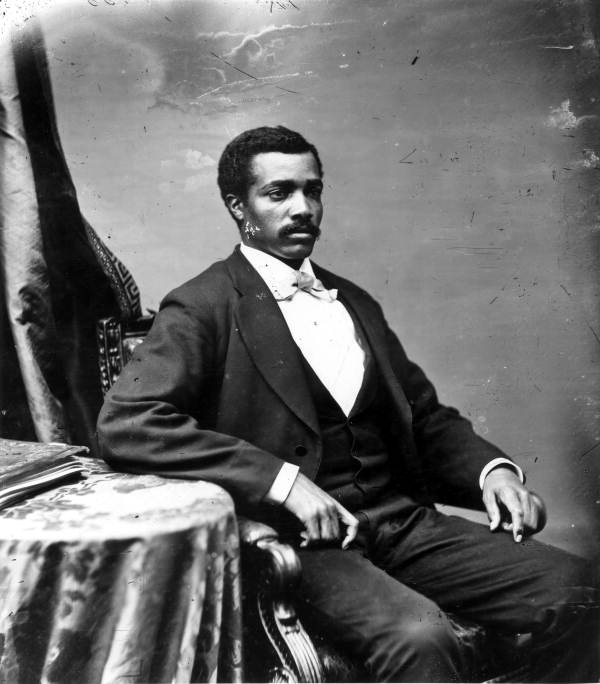
JOSIAH WALLS - Defeated Hamilton in the contest for the Republican party nomination for candidate for Congress at the August 1870 Gainesville convention. Walls unexpectedly emerged as the compromise candidate of choice after the Osborn Ring narrowly failed to win the necessary fifty votes for Robert Meacham and stalemate between the Osborn and Hamilton-Purman camps looked inevitable. Walls's nomination realized J.C. Gibbs's ambition of winning Florida's congressional seat for an Africam American. WALLS, Josiah Thomas, a Representative from Florida; born in Winchester, Frederick County, Va., December 30, 1842; received a limited schooling; engaged in truck farming; moved to Florida; delegate to the State constitutional convention in 1868; served in the State senate 1869-1872; presented credentials as a Member-elect to the Forty-second Congress and served from March 4, 1871, to January 29, 1873, when he was succeeded by Silas L. Niblack, who contested his election; elected as a Republican to the Forty-third Congress (March 4, 1873-March 3, 1875); presented credentials as a Member-elect to the Forty-fourth Congress and served from March 4, 1875, to April 19, 1876, when he was succeeded by Jesse J. Finley, who contested his election; resumed his occupation as truck farmer; died in Tallahassee, Fla., May 15, 1905; interment in the Negro Cemetery. {www.bioguide.congress.gov) After Walls was seated in the 42nd Congress, one of his first activities was pushing through Osborn's Great Southern Railroad legislation that Hamilton had resisted. [Photos from Florida State Archives]
various players from our drama (cont.)

MARCELLUS L. STEARNS - Maine-native Freedmen's Bureau officer for Gadsden County. Stearns recovered Dickinson's body after his murder and presented Dickinson's diary and the Fleishman Affidavits at the KKK Hearings. Stearns was a leading member the Osborn Ring and was entrusted by the Osborns with the distribution, at his discretion, of Great Southern Railroad shares so as to pave the way for passage of supporting legislation through the Florida legislature. Stears served as Florida's governor from 3/1875 to 1/1877. [Photo: Florida State Archives]
various players from our drama (cont.)

MALACHI MARTIN - Irish immigrant - Union army officer who became warden of the state penitentiary at Chattahoochee. Testified at the KKK Hearings about his encounter with Fleishman when Fleishman asked Martin for protection but Martin responded he had no power in chaotic Jackson County. Other than the mysterious Simms (whose statements Martin relates), Martin was the last person to report seeing Fleishman alive. Martin was accused of allowing terrible conditions at his prison.
[Photo: Florida State Archives]
Monday, May 01, 2006
Jonathan C. Gibbs

J.C. Gibbs (1827 - 1874): Distinguished and able radical Republican politician. A native of Pennsylvania, Gibbs graduated from Dartmouth College and came to the South after the war as a Presbytarian missionary. Served in a number of government positions including as Florida's Secretary of State. Gibbs resented the Florida moderate faction's failure to nominate African Americans for high level offices. He correctly saw Hamilton as vulnerable and openly advocated delivering Florida's congressional seat to an African American. Gibbs journied to Jackson County, the base of Hamilton's African American support, to organize opposition to Hamilton simultaneous with Hamilton and Purman's nearly disasterous appearance in August 1870. The convergence of Osborn's revenge and Gibbs's efforts brought about Hamilton's sudden downfall, though Josiah Walls, not Gibbs was the beneficiary. Many considered Gibbs the most impressive and best educated Florida public figure of his era, black or white.
[Photo: Florida State Archives}
Gov. Harrison Reed

Took oath on June 8, 1868; recognized by the federal commander on July 4, 1868; served until January 7, 1873
July 4, 1868 to January 7, 1873
Harrison Reed was born at Littleton, Mass., on August 26, 1813. He moved to Washington, D.C., in 1861 as an employee of the Treasury Department and was sent to Florida by President Abraham Lincoln in 1863 as a tax commissioner to deal with seized Confederate property. Reed gained a reputation for honesty in this office and was appointed Florida’s postal agent by President Andrew Johnson in 1865. He held this position until he was elected governor under the new 1868 Constitution.
Harrison Reed’s administration was a stormy one because he had to cope with a number of factions within his political party, the Republicans. Two serious attempts to impeach him originated with leaders of his own party. At the end of his term, Reed settled down on his farm along the St. Johns River. In 1875, he became editor of the Semi-Tropical, a monthly magazine devoted to southern agricultural and economic development. He died in Jacksonville on May 25, 1899.
[http://dhr.dos.state.fl.us/museum/collections/governors/about.cfm?id=16]
A leader of the Florida "moderate" Republicans together with T.W. Osborn, Reed received the party's nomination for Governor after the close of the Constitutional Convention in Feb. 1868. Soon after Reed assumed office, Reed and Osborn split over patronage issues and financial schemes. Reed survived several impeachment attempts engineered by his nemesis. Hamilton signaled his rejection of the Osborn Ring when he allied himself with the Governor in late 1869. The endorsement of the embattled and isolated Governor proved to be of no value to Hamilton at the August 1870 Republican nominating convention.
Friday, April 28, 2006
A friend "through all the combats that were fought"
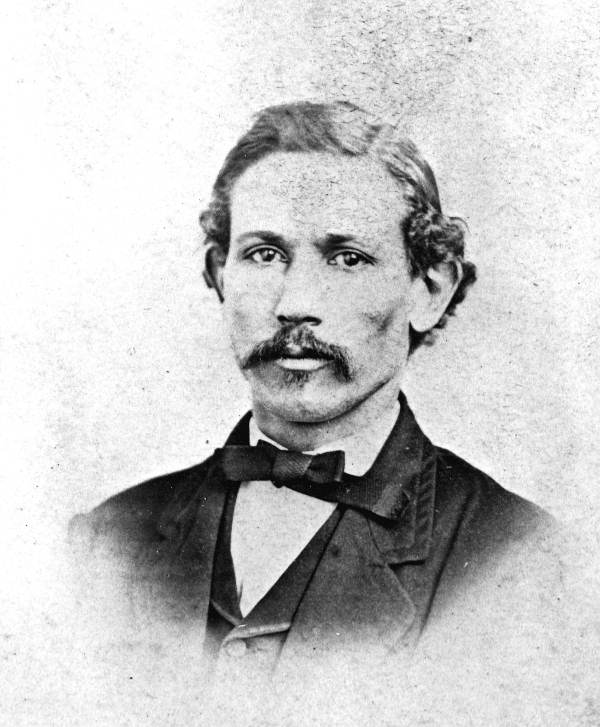
Rev. Emanuel Fortune
[Photo from Florida State Archives]
Born a slave, Emanuel Fortune was a prominent minister and leading Republican party activist in post-War Jackson County. He was elected as a delegate to the Florida constitutional convention in early 1868 and as a Jackson County representative in the state legislature. A close friend of the Bureau agents, he accompanied Hamilton on voter registration and organization drives and may have saved Hamilton's life during a brawl with whites in Walton County. Fearing for life after the Finlayson/Purman shooting, Fortune fled with his family to Jacksonville in the summer of 1869. His son, Timothy Thomas Fortune benefitted from Purman's patronage when the latter was in Congress and became one the leading African American journalists of the early 20th century.
"that good brave, noble, valuable friend..."

Dr. John L. Finlayson
[Photo from Florida State Archives]
Fairly prosperous land and slave owners before the war, the Finlayson family had suffered financially, particularly during the 1864 Union arm raid known as "the Battle of Marianna." The oldest son, Dr. John L. Finlayson, a Confederate army veteran, born in 1838, was about two years older about than Hamilton and Purman and became close friends with the two men. Remarkably, Finlayson allied himself with the Bureau, providing medical services to freedmen and teaching adults at the Bureau night school in Marianna. He attended a Florida Republican convention in 1867 and accepted appointments as Bureau medical officer and later clerk of court for Jackson County (July 1868). Dr. Finlayson was shot dead by a concealed assassin on the night of Feb. 26, 1869 in the town of Marianna while walking together with Purman after attending a minstrel performance by the local army garrison. Shortly after John's death, his sister Mary Martha married Charles Hamilton. In October 1871, sister Leodora married Purman. In a letter to Dickinson, Hamilton recalled Finlayson, "that good brave, noble, valuable friend, whom I loved with an almost holy affection." John L. Finlayson's burial place is unknown.
Addendum (Jan. 2007):
Reading through the Florida legislative journals, I learned that Finlayson's assassination was followed by the "almost immediate death of his wife, who fell an innocent victim to grief in devotion to her husband." The Finlaysons left behind "two little orphans": Sallie (born about 1865) and John P. (born Nov. 1867). In Jan. 1870, state Senator Purman introduced a bill entitled "An Act for the relief of the children of Dr. John L. Finlayson, late Clerk of the Circuit Court of Jackson county." The bill passed and the children were awarded an annual payment of $300 for the period of ten years.
Addendum (Feb. 2007)
The orphaned Finlayson children, John P. and Sallie, are listed in the 1870 census living in Mobile, Ala. with a family named Bond. Presumably the Bonds are the family of their late mother. John P. continued to live in Mobile, married Lillie Ellen Barry, and had a son in 1895 whom he named John Purman Finlayson. "Purman Finlaysons" have resided in Mobile to this day. According to a descendant, the family became quite successful in the grocery business.
Wednesday, April 26, 2006
"almost inseperably associated for the greater part of our lives"
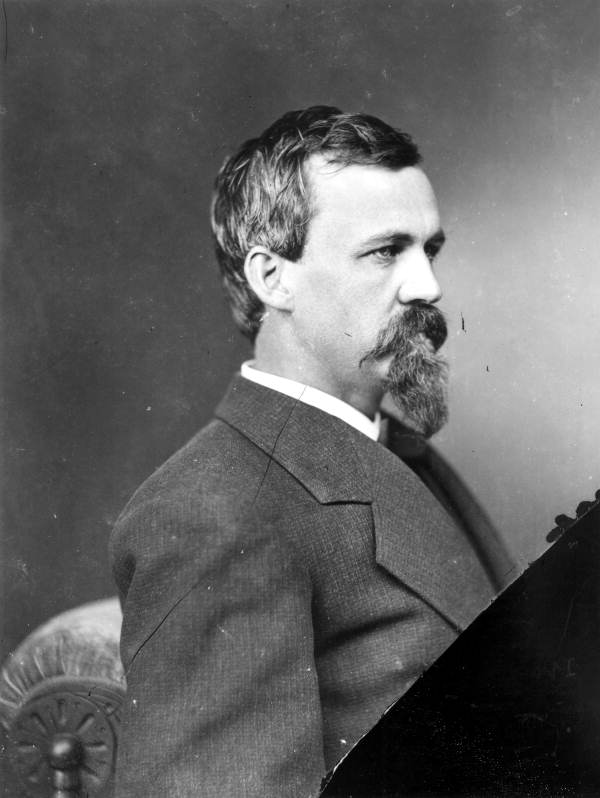
William J. Purman: Charles Hamilton's boyhood friend, fellow veteran, political ally, and brother-in-law. Hamilton obtained Purman's appoinment as Freedmen's Bureau civilian agent for Jackson County, FL obstensibly under Hamilton's command, though the two shared their duties as equals for almost two difficult years [photo: Florida state archives].
PURMAN, William James, a Representative from Florida; born in Millheim, Centre County, Pa., April 11, 1840; attended the common schools and completed his studies at Aaronsburg Academy, Centre County, Pa.; taught school; studied law at Lock Haven, Pa.; during the Civil War entered the Union Army as a private and served on special duty at the War Department until transferred to Florida in 1865; was admitted to the bar in 1868 and commenced practice in Tallahassee, Fla.; member of the State constitutional convention in 1868; served in the State senate 1869-1872; appointed by the Governor and confirmed by the State senate as secretary of state in 1869, but declined; chairman of the Florida Commission in 1869 for entering into negotiations for transfer of West Florida to the State of Alabama, which transfer was not ratified by Alabama; assessor of United States internal revenue for the district of Florida 1870-1872; chairman of the Republican State committee 1870-1872; member of the Republican National Committee 1876-1880; elected as a Republican to the Forty-third Congress and served from March 4, 1873, to January 25, 1875, when he resigned; member of the State house of representatives for one session and resigned when elected to Congress; elected to the Forty-fourth Congress (March 4, 1875-March 3, 1877); unsuccessful candidate for reelection in 1876 to the Forty-fifth Congress; returned in 1878 to Millheim, Pa., and engaged in agricultural pursuits; moved to Boston, Mass., in 1883; moved to Washington, D.C., where he lived in retirement until his death on August 14, 1928; the remains were cremated and the ashes deposited in a vault at Glenwood Cemetery. [www.bioguide.congress.gov]
Interestingly this biography does not mention the 2 1/2 years (spring 1866 to September 1868) that Purman was Freedmen's Bureau agent for Jackson County, FL.
Tuesday, April 25, 2006
T.W. Osborn: the villain of our story
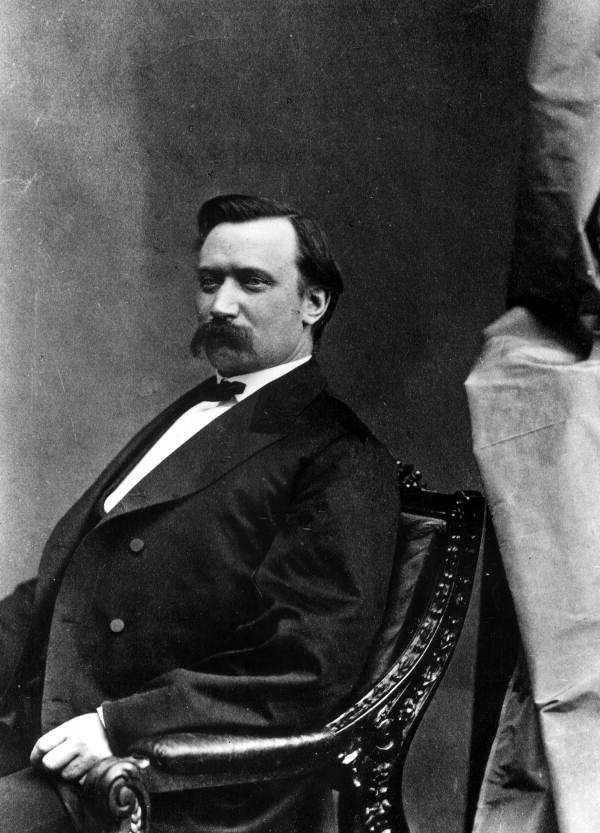
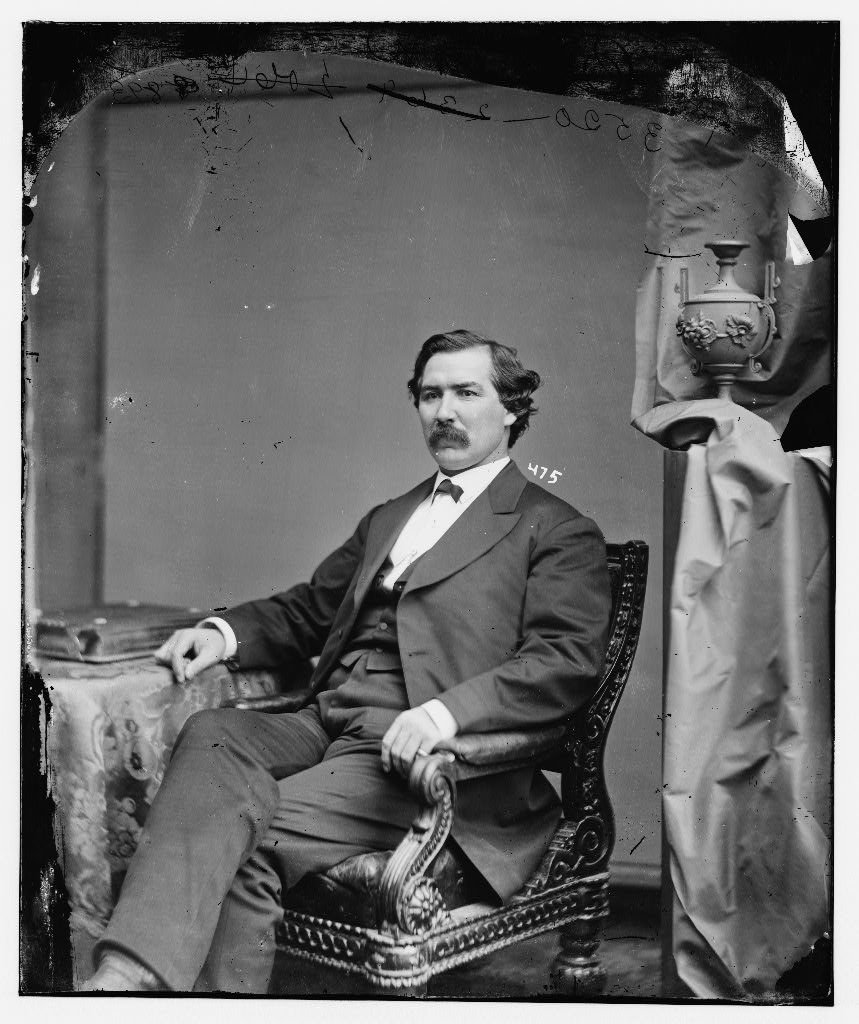
OSBORN, Thomas Ward, a Senator from Florida; born in Scotch Plains, Union County, N.J., March 9, 1833; moved to New York in 1842 with his parents, who settled in North Wilna; attended the common schools and graduated from Madison (now Colgate) University, Hamilton, N.Y., in 1860; studied law and was admitted to the bar in 1861; during the Civil War entered the Union Army in 1861 as lieutenant and became captain, major, and colonel of Battery D, First Regiment, New York Light Artillery; appointed assistant commissioner of the Bureau of Refugees and Freedmen for Florida 1865-1866; settled in Tallahassee, Fla., and commenced the practice of law; appointed register in bankruptcy in 1867; member of the State constitutional convention in 1868; moved to Pensacola, Fla.; member, State senate; upon the readmission of Florida to representation was elected as a Republican to the United States Senate and served from June 25, 1868, to March 3, 1873; was not a candidate for reelection; served as United States commissioner at the Centennial Exposition in Philadelphia, Pa., in 1876; moved to New York City and resumed the practice of law; also engaged in literary pursuits; died in New York City, December 18, 1898; interment in Hillside Cemetery, North Adams, Berkshire County, Mass [www.bioguide.congress.gov]
BUT WE KNOW "THE REST OF THE STORY!"
[Left photo from Florida State Archives/ right from Library of Congress]
More biographical information about T.W. Osborn:
GENERAL THOMAS W. OSBORN, son of Jonathan and Amelia Osborn ....After graduation he entered the law-office of Starbuck & Sawyer, at Watertown, being admitted to practice law in 1861. It was not until after the battle of First Bull Run that he determined to do what hecould to sustain the government. He raised a company for light artilleryservice, afterwards known as Company D, First New York Light Artillery. Ofthis command he was commissioned captain. The battery served continuouslywith the Army of the Potomac and engaged in more than 30 pitched battles,from the Peninsula to Gettysburg, proving itself one of the best artilleryforces in the army, only equaled by the battery of Mink and Spratt, also raised in Jefferson, St. Lawrence and Lewis counties. After this generaland entirely truthful statement it is not necessary to go into details, for Osborn's battery has a record that can be found in the history of the Army ofthe Potomac. The services of Captain Osborn were so meritorious that he was rapidly promoted from one grade to another, having been chief of artillery ofthe second division of the second corps, under General Berry, with the rankof major; in 1863 he was promoted to the command of the second brigade of thevolunteer artillery of the Army of the Potomac; and in June, 1863, was madechief of artillery of the second corps, under General Howard, in whichcapacity he went through with the battle of Chancellorsville. In 1864 he was transferred to the Army of the Cumberland, and was chief of artillery of thefourth corps of that army; and while thus employed was seriously wounded.While in command of the recruiting barracks at Louisville, Ky., he organizedthe 106th, 107th and 108th regiments of colored troops. Returning to thefront as soon as convalescent, on the 28th of July, 1864, he was assigned, byGeneral Sherman, as chief of artillery of the Army and Department of theTennessee, commanded by General Howard. This assignment gave Major Osbornthe largest artillery command held by any officer during the war, with theone exception of Major-General Barry, who was General Sherman's chief of artillery. November 1, 1865, upon the organization of Sherman's army for the Savannah campaign, Major Osborn was relieved from the command of theartillery of the department, and retained that of the moving army. December 21, 1864, in addition to his other duties, he was put in command and hadcharge of all the artillery, light and heavy, captured at Savannah; January 9, 1865, he received his previous command of the artillery only with themoving army and entered upon the Carolina campaign. This he retained untilMay 10, 1865, when he was relieved by the Secretary of War and assigned to other duty.
From: The Growth of a Century: As Illustrated in the History of Jefferson, County, New York, from 1793 to 1894, John A. Haddock, Philadelphia, Sherman & Co., 1894. Page 822.
Found at http://home.att.net/~osborne-origins/biograph/bio25.htm
Monday, April 24, 2006
Yet another Hamilton portrait
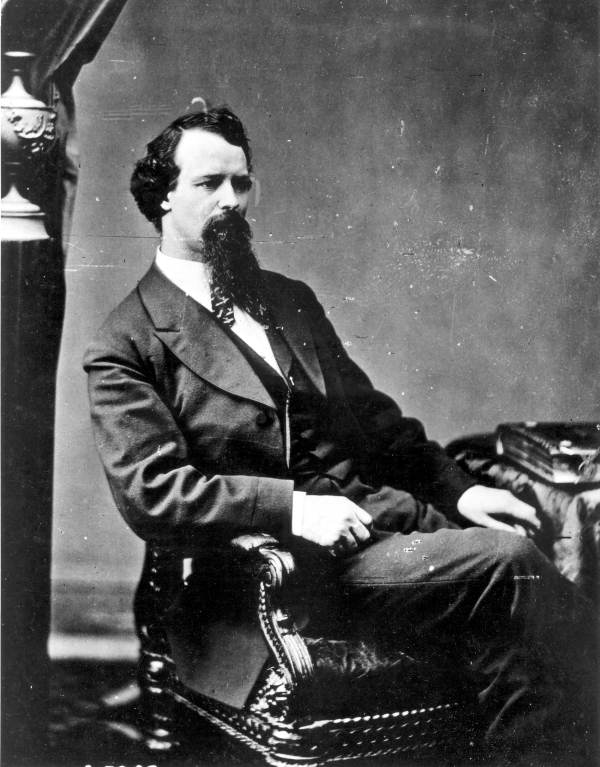
This photo is from the Florida State Archives (Florida Memory Photographic Collection) http://www.floridamemory.com/PhotographicCollection
This photo is also available at the private collection website: Picture History: http://www.picturehistory.com/find/p/5739/mcms.html
Sunday, April 23, 2006
John Quincy Dickinson Letters
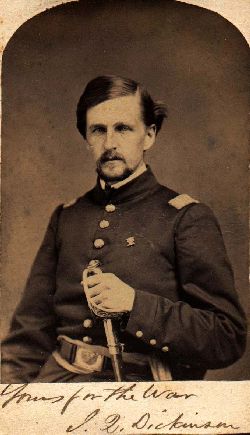
I am not sure what to do with the John Q. Dickinson material I have gathered. In any event, here's a list of writings and letters which I have found:
J.Q. Dickinson to "Dear Mother," Tallahassee, FL., Aug. 13, 1868 (UVT Library)
A.H. Jackson to J.Q. Dickinson, ___, Sept. _, 1868 (Freedmen's Bureau Records)
J.Q. Dickinson to A.H. Jackson, Marianna, Fl., Sept. 15, 1868 (FB Records)
J.Q. Dickinson to A.H. Jackson, Marianna, Fl., Sept. 17, 1868 (FB Records)
J.Q. Dickinson to A.H. Jackson, Marianna, Fl., Oct. 1, 1868 (FB Records)
J.Q. Dickinson to Rutland Herald (pub. 4/15/69) - titled "A Letter from Florida" subtitled "The Murder of Dr. Finlayson, dated Marianna, Jackson Co. , Florida April 5, 1869.
J.Q.D. to "Dear Father", Marianna, Fla, April 11, 1869 (UVT Library)
Malachi Martin to J.Q. Dickinson, State Penitentiary, Fla. Aug. 10, 1869 (fr. Benson, VT. Historical Society)
JQD "Memoranda and Occurences": Sept. 28 - Oct. 26, 1869 (Kaplan Collection)
J.Q. Dickinson to C.M. Hamilton, Marianna, Sept. 30, 1869 (Congress Hearings)
J.Q. Dickinson to C.M. Hamilton, Marianna, Oct. 3, 1869 (Congress Hearings)
JQD: Fleishman Affadivits, Oct. 4, 1869 (Kaplan Collection)
J.Q. Dickinson to C.M. Hamilton, Marianna, Oct. 7, 1869 (Congress Hearings)
J.Q. Dickinson to C.M. Hamilton, Marianna, Oct. 11, 1869 (Congress Hearings)
C.M. Hamiton to J.Q. Dickinson, Washington, Dec. 29, 1869 or 1870 (Kaplan Collection)
J.Q. Dickinson to G. Gile, Marianna, Florida, Feb. 24, 1870 (FB Records)
W.J. Purman to J.Q. Dickinson, Tallahassee, Fla. Oct. 5, 1870 (UVT Library).
J.M. Hawks to J.Q. Dickinson , Pensacola, Fl., Nov. 25, 1870 (UVT Library)
Benj. Thompson to J.Q. Dickinson, Ship Peruvian, Savannah, Dec. 2, 1870 (UVT Library)
Laurie (?) Thompson to J.Q. Dickinson "
Hart Collins (?) to J.Q. Dickinson, Orange Hill (?), Fl, Dec. 9, 1870 (UVT Library)
Benj. Thompson to J.Q. Dickinson, Ship Peruvian, Savannah, Dec. 25, 1870 (UVT Library)
J.C. Gibbs to J.Q. Dickinson, Tallahassee, Feb. 14, 1871 (UVT Library)
J.Q. Dickinson to J.C. Gibbs, Marianna, Feb. 23, 1871 (Congress. Hearings)
W.J. Purman to J.Q. Dickinson, Tallahassee, Fla., March 10, 1871 (UVT Libary)
OTHER RELATED LETTERS
A.J. Dickinson to "Dear Mother," Marianna Post Office, April 4, 1871 [mistakenly dated by A.J., should be May 4, 1871] (UVT Library)
W.J. Purman to Isaac Dickinson, Tallahassee, April 8, 1871 (private collection)
W.J. Purman to Isaac Dickinson, Tallahassee, April 17, 1871 (UVT Library)
D.B. Peck to Isaac Dickinson & Family, Washington DC, April 17, 1871 (UVT Library)
W. Chapman to I. Dickinson, Marianna, Jackson Co., Florida, April 29, 1871 (UVT Library)
P.R. Sherwood to Mrs. Dickinson, Knox Co. Ohio, April 2_, 1871 (UVT Library)
Isaac Dickinson to W.H. Milton, Benson, Vt., Sept. __, 1874 (UVT Library)
Isaac Dickison to Mr. Chapman, Benson, Vt., Feb. 13, 1875 (UVT Library)
W.H. Milton to Isaac Dickinson, Marianna, Fl., April 15, 1879 (UVT Library)
SEE ALSO: Wartime letters from JQD to Rutland Herald dated March 13, April 5, April 27, May 1, July 15, 1862; July 4, 1863; Aug. 20, 1864 reprinted in Donald H. Wickman, Letters to Vermont from her Civil War soldier correspondents to home press (Bennington, Vt., 1998), vol. II;
manuscript diary, 88 pages, March 10 - May 6, 1862 in possession of UVT Library;
J.Q. Dickinson to "Dear Uncle", Baton Rouge, LA, Aug. 10, 1862 (Navarro College, Texas).
J.Q. Dickinson to "Dear Mother," Metropolitan Hotel, NY, March 11, 1862 (BensonHS)
J.Q. Dickinson to "Dear Mother," Ship Island, April 4, 1862 (BHS)
J.Q. Dickinson to Dugald Stewart, Near Carrollton, La., Sept. 1, 1862 (Jeffrey D. Marshall, ed., A War of the People: Vermont Civil War Letters.)
J.Q. Dickinson to "Dear Father," Fort Pickens, La., Dec. 3, 1863 (BHS)
J.Q. Dickinson to "Dear Father," Barnacas, La. May 17, 1864 (BHS)
J.Q. Dickinson to "Dear Father," New Orleans, Jan. 14, 1865 (BHS)
J.Q. Dickinson to "Dear Father," New Orleans, Oct. 18, 1865 (UVT Library)
[updated April 21, 2010]
[photo: http://www.vermontcivilwar.org/units/7/jqd.php ]
Tuesday, April 11, 2006
Another Hamilton Congressional Portrait (with longer beard!)
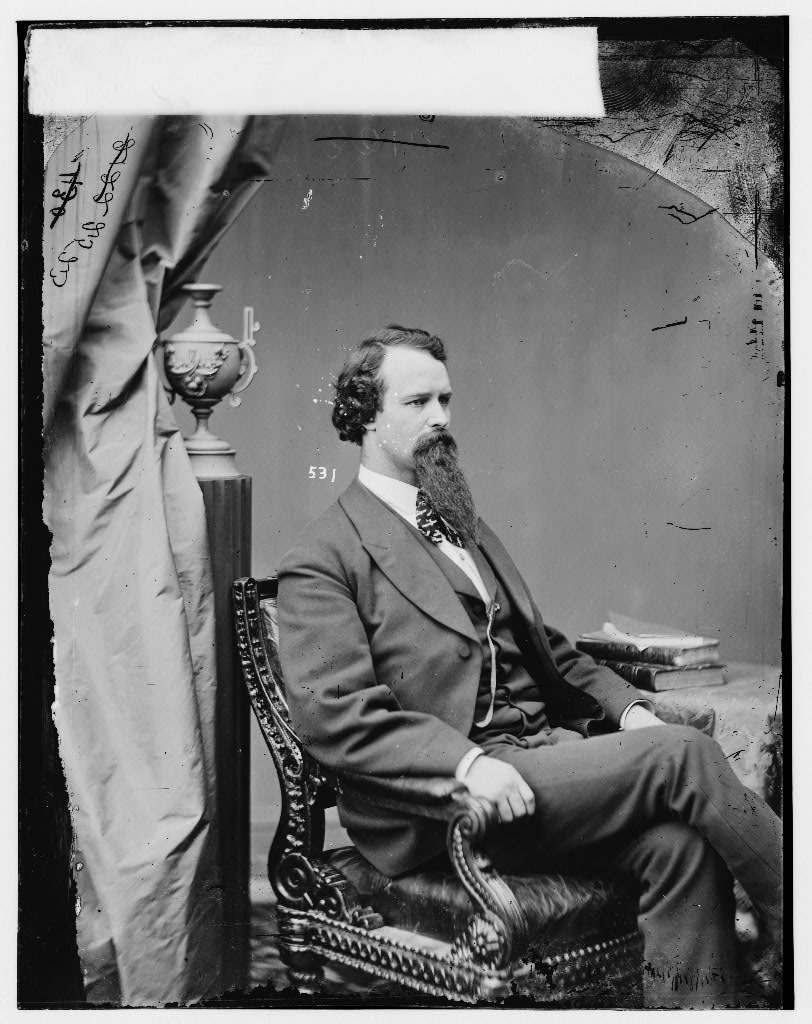
Here is "Handsome Charley" - the youngest member of the 40th Congress - no more than thirty, impressively goateed, poised and at the peak of his career. No foreboding of the pathetic end he would find in just another half-dozen years (Photo from Library of Congress).
Monday, April 10, 2006
Grave Inscriptions
East:
Col. Charles M. Hamilton
_____ son of
John & Hannah Hamilton
Died Oct. 22, 1875
In the 35th year
of his age
North:
Commissioner Freedmen
Bureau for Florida 1865
Represented Fla in the
40th and 41st Congress
West:
An officer in ____
________ _________1861
_________ Penn.
Reserves
South:
Post Master Jacksonville
Fla. ______
Collector Customs ___Key
West, Fla. 1873
Col. Charles M. Hamilton
_____ son of
John & Hannah Hamilton
Died Oct. 22, 1875
In the 35th year
of his age
North:
Commissioner Freedmen
Bureau for Florida 1865
Represented Fla in the
40th and 41st Congress
West:
An officer in ____
________ _________1861
_________ Penn.
Reserves
South:
Post Master Jacksonville
Fla. ______
Collector Customs ___Key
West, Fla. 1873
Hamilton's Grave: Jersey Shore Cemetery, Jersey Shore, Pennsylvania (July 2005)


The grave of Charles M. Hamilton is the smaller of the two obelisks. The larger is the marker of Charles's younger brother, John L., killed in action at Petersburg one week before Lee's surrender. The small rounded markers in front of the obelisks in the picture on the left are the graves of John (left) and Hannah (right) Hamilton, the parents of Charles and John.
Saturday, April 08, 2006
Charles M. Hamilton
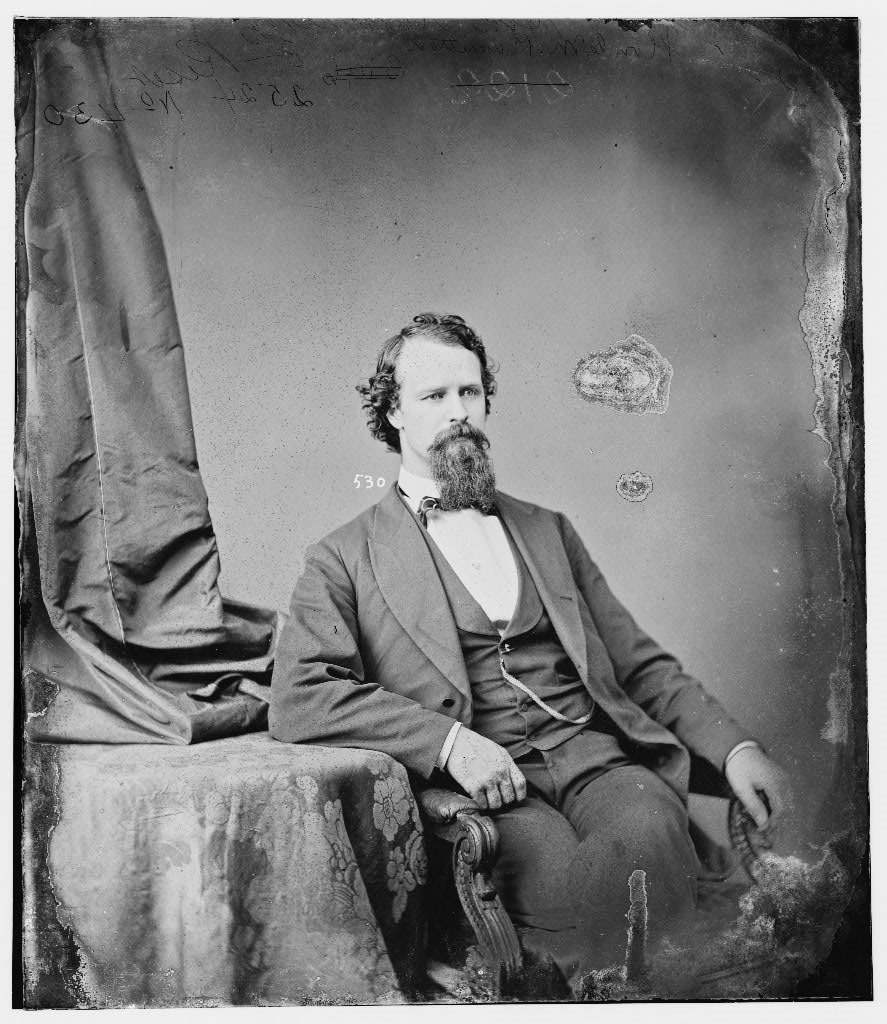

Charles Memorial Hamilton: Congressional portraits taken by Brady studio sometime between July 1868 and March 1871. The Library of Congress has different portraits, possibly from three different sittings.
B. Altman and the Fleishmans
When Sophia returned to New York with her children after her husband's murder, her brother Morris led the business that had been founded by their father. In 1872, however, the youngest Altman sibling, Benjamin, established his own “fancy” and dry goods store under the name “B. Altman and Company.” Morris died suddenly at the age of thirty-nine in July 1876, leaving Benjamin to manage the family businesses. At the time of Morris Altman’s death, the Altman brothers were already quite successful merchants and employed over two hundred people. Morris had been a greatly respected businessman and was a prime mover behind the effort toward advocating shorter working hours for dry goods clerks (New York Times, July 14, 1876, p. 4. Henry Hall, ed., America’s Successful Men of Affairs: An Encyclopedia of Contemporaneous Biography, vol. 1 (New York, 1895-96), 16). Morris’ widow died shortly after him and Benjamin assumed responsibility for raising Morris’ four children. Consequently, in addition to operating a large and growing business, Benjamin Altman, thirty-six years old, now had ten fatherless young nieces and nephews in his care. These burdens may very well explain why Benjamin never married and had children of his own.
At his death in 1913, the New York Times estimated Altman to be worth forty-five million in real estate, art holdings and his B. Altman stock (New York Times, October 8, 1913). He donated his celebrated art collection to the Metropolitan Museum Art which was acclaimed at the time as the “most splendid gift that a citizen has ever made to the people of the city of New York” (Metropolitan Museum of Art, Guide to Altman Collection, 13. His collection included, at various times, thirteen major Rembrandts). Altman also became known as a patron of American artists and was commended as a philanthropist who avoided publicizing his charitable works. A biographical note commended Altman for his devotion to the care and education of Morris’ four orphaned children (Hall, America’s Successful Men, 17). Altman remained attached to Judaism and was a member of Temple Emanu-El. After Altman’s death in 1913, Adam Schiff unsuccessfully urged the editors of the Evening Post to mention that Altman “had lived and died as a Jew” (David Levering Lewis, W.E.B. Du Bois - Biography of a Race, 1868-1919 (New York, 1993), 488-9). Altman left his store, B. Altman & Co., in the care of his foundation for the benefit of charitable causes and the employees.
At his death in 1913, the New York Times estimated Altman to be worth forty-five million in real estate, art holdings and his B. Altman stock (New York Times, October 8, 1913). He donated his celebrated art collection to the Metropolitan Museum Art which was acclaimed at the time as the “most splendid gift that a citizen has ever made to the people of the city of New York” (Metropolitan Museum of Art, Guide to Altman Collection, 13. His collection included, at various times, thirteen major Rembrandts). Altman also became known as a patron of American artists and was commended as a philanthropist who avoided publicizing his charitable works. A biographical note commended Altman for his devotion to the care and education of Morris’ four orphaned children (Hall, America’s Successful Men, 17). Altman remained attached to Judaism and was a member of Temple Emanu-El. After Altman’s death in 1913, Adam Schiff unsuccessfully urged the editors of the Evening Post to mention that Altman “had lived and died as a Jew” (David Levering Lewis, W.E.B. Du Bois - Biography of a Race, 1868-1919 (New York, 1993), 488-9). Altman left his store, B. Altman & Co., in the care of his foundation for the benefit of charitable causes and the employees.
Friday, April 07, 2006
Senator Thurston's Unfortunate (and Recycled?) Poem
As discussed in a previous post, Nebraska Senator John Thurston's marriage to much younger Lola Purman, not long after his wife's death, and his poem to Lola, titled "The White Rose" may have caused a scandal that ruined his political career. The Chicago Tribune described Lola as "about 25" and "pretty and brilliant." The rose poem was precipitated by Lola's having "presented the Senator with a rose at the opera last winter, which resulted in his poem which has now become famous" (Nov. 14, 1899). Thurston denied, however, that he wrote the poem for "Miss Purman" but protested that it was a "youthful effusion written 30 or more years ago" (Tribune, Nov. 18, 1899). The couple married on Nov. 18, 1899 at the Purman household in D.C.
Subscribe to:
Posts (Atom)